| LOST JEEPS http://www.lostjeeps.com/forum/phpBB3/ |
|
| Strait Pipe or not to Strait Pipe??? http://www.lostjeeps.com/forum/phpBB3/viewtopic.php?f=5&t=35867 |
Page 1 of 3 |
| Author: | 2mopar_diesels [ Fri Sep 12, 2008 4:11 pm ] |
| Post subject: | Strait Pipe or not to Strait Pipe??? |
I'm the proud new owner of a black '05 CRD Sport, and this is my 1stpost on here. I was looking into a good cat-back exhaust for the new CRD, saw the prices, and thought, "if the ol' Dodge diesel sounds good with a strait pipe", just what would the Libby sound like without a muffler but leaving the cat??? |
|
| Author: | geordi [ Fri Sep 12, 2008 4:50 pm ] |
| Post subject: | |
It will sound like it can get another 2-3mpg, and coast forever and a day. You will be happy. The sound increase is not terrible, but I decided to lighten the load by removing that ridiculously sized muffler AND the 50 lbs of feline under there, and replace them with a Flowmaster all-metal muffler. Your decisions may vary, but I do feel that losing close to 100 lbs of crap and restriction was good for 3-4mpg on mine. |
|
| Author: | ac5501 [ Fri Sep 12, 2008 4:52 pm ] |
| Post subject: | |
Barely noticeable at idle, a little bit more noise as you accelerate. I was worried about that when I got rid of my "exhaust brake" but after trying it, I have no problem whatsoever with the little extra noise. Nothing that will get you pulled over. Not even close. In fact, over the road noise easily drowns out the exhaust noise especially on the freeway with windows even partially open |
|
| Author: | fastRob [ Fri Sep 12, 2008 5:01 pm ] |
| Post subject: | Hard Telling |
I went with a custom 3" catback and 3" magnaflow because I tow and am thinking about going to the turbo with larger pipe.. The muffler is about useless. I noticed no increase in fuel mileage. Of course it could be that the "Happy Feet" are at it. The 2 1/2" magnaflow system is sweet for the money, check it out. If I had it to do over would probably just leave it all alone, but I do like the whine and rattle and maybe it breathes a little easier at heavy throttle. |
|
| Author: | geordi [ Fri Sep 12, 2008 5:19 pm ] |
| Post subject: | Re: Hard Telling |
fastRob wrote: I went with a custom 3" catback and 3" magnaflow because I tow and am thinking about going to the turbo with larger pipe..
The muffler is about useless. I noticed no increase in fuel mileage. Of course it could be that the "Happy Feet" are at it. The 2 1/2" magnaflow system is sweet for the money, check it out. If I had it to do over would probably just leave it all alone, but I do like the whine and rattle and maybe it breathes a little easier at heavy throttle. Heavy throttle is the same as light throttle - Diesels always breathe the same, no throttle plate to restrict the airflow. |
|
| Author: | fastRob [ Fri Sep 12, 2008 5:53 pm ] |
| Post subject: | Re: Hard Telling |
geordi wrote: Heavy throttle is the same as light throttle - Diesels always breathe the same, no throttle plate to restrict the airflow. Do not know what you are trying to say. WFO uses more fuel than egg under the pedal. A freer flow exhaust can flow more spent gasses at highest limits of engine operation, ok? |
|
| Author: | nursecosmo [ Fri Sep 12, 2008 6:22 pm ] |
| Post subject: | |
geordi wrote: It will sound like it can get another 2-3mpg, and coast forever and a day. You will be happy. The sound increase is not terrible, but I decided to lighten the load by removing that ridiculously sized muffler AND the 50 lbs of feline under there, and replace them with a Flowmaster all-metal muffler. Your decisions may vary, but I do feel that losing close to 100 lbs of crap and restriction was good for 3-4mpg on mine. geordi wrote: Heavy throttle is the same as light throttle - Diesels always breathe the same, no throttle plate to restrict the airflow.
I'm confused. First you imply that the breathing is restricted to the tune of 2-3MPG, then that they always breath the same. What were you really saying? |
|
| Author: | DarbyWalters [ Fri Sep 12, 2008 6:51 pm ] |
| Post subject: | |
Lets not start a throttle/no throttle thread here. Our Diesel does not have a throttle. It eats the same amount of air basically all the time. Your speed/power is affected by the amount of fuel you add to the air. As you add more fuel the mixture is richer and more power and smoke is made. A/F (air to fuel ratios) can range form ~ 5:1 to 80:1. On a gasser they need to stay around 12.7:1 to 14:1 or so. This is why the Air Filter is so important on a Diesel...it is a big air pump. 3" pipe:
Extended Tip down a bit:
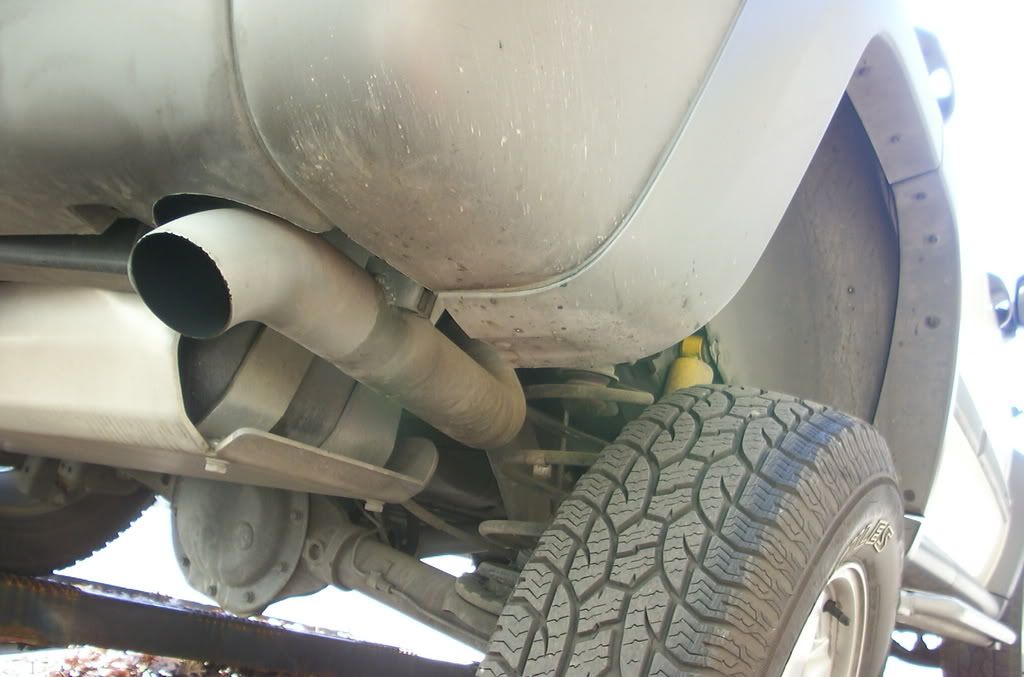
My "Other Diesel" at full speed:

|
|
| Author: | warp2diesel [ Fri Sep 12, 2008 7:19 pm ] |
| Post subject: | As the torbo revs up it draws more air... |
.. and the exhaust flow increases as well, add more fuel to the engine the exhaust gets hotter and expands more and increases in volume. As the exhaust volume and temp increase the turbo revs higher until it reaches its terminal speed or the ECM cuts back on the fuel to keep the boost down. Put in a hop up chip, re tune the ECM, or shove resistors in the boost pressure and rail pressure line circuits the volume of exhaust will increase due to more fuel, hence bigger pipes help the flow. But the place the exhaust comes out can make a difference in the engine produces. You could hang a big Boeing type 777 tail (not tail rudder) on the back and vent a 6" exhaust the same place Boeing vents the APU and every thing would be great until you got a strong cross wind and got blown off the road. To put PV=NKT into perspective you are flowing more cubic feet out the exhaust at 1200f EGT and 15 PSI boost @ 2000 RPM than you are at 600f EGT and 0.0 PSI @2000 RPM . Why, more fuel more heat, more expansion of the exhaust and more air coming in do to higher turbo boost. |
|
| Author: | nursecosmo [ Fri Sep 12, 2008 7:26 pm ] |
| Post subject: | |
DarbyWalters wrote: Lets not start a throttle/no throttle thread here.
Our Diesel does not have a throttle. It eats the same amount of air basically all the time. Your speed/power is affected by the amount of fuel you add to the air. As you add more fuel the mixture is richer and more power and smoke is made. A/F (air to fuel ratios) can range form ~ 5:1 to 80:1. On a gasser they need to stay around 12.7:1 to 14:1 or so. This is why the Air Filter is so important on a Diesel...it is a big air pump. Nice pipe. Of course it doesn't eat the same amount of air all the time. Under full boost it is sucking twice as much air per intake stroke as at idle. Conversely the exhaust back pressure after the turbo is twice as much under boost. By opening it up better flow is archived improving efficiency and MPG. |
|
| Author: | DarbyWalters [ Fri Sep 12, 2008 10:33 pm ] |
| Post subject: | |
The amount of "fresh air" that runs thru a Diesel since there are no throttle restrictions remains almost constant. The fuel delivery increases as boost and load are applied...that is why A/F Ratios vary so much on a diesel... The turbo does "pack" more air in the cylinders under boost...but the "fresh air" only changes due to movement of the vehicle. |
|
| Author: | nursecosmo [ Sat Sep 13, 2008 12:42 am ] |
| Post subject: | |
DarbyWalters wrote: The amount of "fresh air" that runs thru a Diesel since there are no throttle restrictions remains almost constant. The fuel delivery increases as boost and load are applied...that is why A/F Ratios vary so much on a diesel...
The turbo does "pack" more air in the cylinders under boost...but the "fresh air" only changes due to movement of the vehicle. I am still trying to figure out what exactly you are referring to. The amount of fresh air that moves through the engine is absolutely NOT constant. Nor is it "almost" constant. It is highly variable. The variability of flow has nothing to do with a throttle plate or lack thereof (gasoline engines also have a high degree of flow variability). A 2.8L 4 cylinder diesel engine is moving 5.6 liters of air at 1 RPM, at 1000 RPM and 0 PSI of boost. It moves 5600 liters of air if there is no restriction through the airbox, filter, ducting etc, or at the outlet. At the same 1000 RPM and 15 PSI of boost it is moving 11200 liters of air. In order to "pack" that air into the engine it has to move twice as much air through the airbox. But the effort to move it through the same diameter restrictions is more than doubled. Now this is all considering that the temperature of the air is not changing, however since we are talking about an internal combustion engine we have to factor in the heat that is added by the fuel. As the above mentioned 5.6 liters of air is heated to over 1000 degrees F, it's volume wants to more than double but cant which effectively multiplies the PSI to more than quadruple that of the initial 14.7 PSI of the intake air. So the initial 11200 liters of air that went through the air filter in one minute becomes 22400 liters of air that exits out the pipe. Multiply X 3 for accelerating to 3000 RPM on the Hwy ramp and you get 67200 LPM. That is a LOT of air to move through a 2" pipe (67 cubic meters). Anything which opens up the exhaust flow path can reduce the back pressure in the cylinders considerably which will improve efficiency and MPG. The A/F ratio has nothing to do with the restrictions to the air flow. If the engine is moving 22400 liters of air at 1000RPM, the A/F mix could be 5:1 or 80:1, it would not matter because the resistance to flow would still be the same. The amount of fresh air going through the airbox has nothing to do with vehicle speed. It will still move 22400 liters whether stationary on the dyno or moving down the highway. |
|
| Author: | geordi [ Sat Sep 13, 2008 12:51 am ] |
| Post subject: | |
Darby explained what I obviously wasn't clear with, ah, it made sense in my head. But NurseComo... Now my head hurts from all the new thinking I have to wrap my brain around. |
|
| Author: | 2mopar_diesels [ Sat Sep 13, 2008 1:41 am ] |
| Post subject: | |
Dang, I've been hijacked and this got off topic real quick!!! |
|
| Author: | mrkake [ Sat Sep 13, 2008 4:30 am ] |
| Post subject: | |
I for one would like to see this thread get back on topic. I am wondering the same thing. How loud is a straight pipe? Do you run it along the same path that the original set up followed or just angle it down where the cat used to be? Are there any advantages to leaving the cat on? What about losing the cat and leaving the muffler (or an easier breathing after market muffler)? What mufflers are good if going that route? Inquiring minds want to know |
|
| Author: | Larry R. [ Sat Sep 13, 2008 2:12 pm ] |
| Post subject: | |
I too would like to get back on topic, what is the interior noise like? |
|
| Author: | 2mopar_diesels [ Sat Sep 13, 2008 2:50 pm ] |
| Post subject: | |
There are two reasons I see in wanting/needing the cat to stay in place. 1. Warranty reasons! I along with many others still have a factory warranty left and removing the cat would void warranties, along with violating many state's laws. 2. As long as its in good working order, the cat will act as a resonator to keep annoying drone from developing and smooths the exhaust pulses. But my experience with that is limited to the larger diesels in fullsize trucks like my 2500 Dodge. Most like the sound of a strait pipe with cat, as the full strait is usually too loud and will have a bad highway speed drone. |
|
| Author: | nursecosmo [ Sat Sep 13, 2008 5:58 pm ] |
| Post subject: | |
2mopar_diesels wrote: There are two reasons I see in wanting/needing the cat to stay in place.
1. Warranty reasons! I along with many others still have a factory warranty left and removing the cat would void warranties, along with violating many state's laws. 2. As long as its in good working order, the cat will act as a resonator to keep annoying drone from developing and smooths the exhaust pulses. But my experience with that is limited to the larger diesels in fullsize trucks like my 2500 Dodge. Most like the sound of a strait pipe with cat, as the full strait is usually too loud and will have a bad highway speed drone. Who is off topic? Every post so far in this thread has been about the virtues of decreasing the breathing restriction through the engine by straight piping. I gutted my cat before my warranty expired. During the couple of visits that I made to the dealer they never even suspected that the cat was hollow. How could they? There is no way to tell just by looking. It passed the emissions inspection with flying colors on biodiesel. The noise was barley increased at idle. At highway speeds there was no detectable change in noise. My next project is to remove the muffler completely for better flow and more whine from the turbo. |
|
| Author: | danoid [ Sat Sep 13, 2008 8:51 pm ] |
| Post subject: | |
** OFF TOPIC ** BTW we do have a throttle... It serves two purposes. 1) on engine shutdown it clamps to reduce shake. A Cummins will actually spin slightly backward as that last piston is compressed and doesn't fire. That's what gives them that belt squeak. On our cars, it's also responsible for that click about 20 seconds after turning the truck off, that's when it reopens. 2) on light load it clamps a little to increase EGR flow. |
|
| Author: | nursecosmo [ Sat Sep 13, 2008 9:45 pm ] |
| Post subject: | |
danoid wrote: ** OFF TOPIC **
BTW we do have a throttle... It serves two purposes. 1) on engine shutdown it clamps to reduce shake. A Cummins will actually spin slightly backward as that last piston is compressed and doesn't fire. That's what gives them that belt squeak. On our cars, it's also responsible for that click about 20 seconds after turning the truck off, that's when it reopens. 2) on light load it clamps a little to increase EGR flow. You do but we don't. Mine is unplugged |
|
| Page 1 of 3 | All times are UTC - 5 hours [ DST ] |
| Powered by phpBB © 2000, 2002, 2005, 2007 phpBB Group http://www.phpbb.com/ |
|