LOST JEEPS
http://www.lostjeeps.com/forum/phpBB3/

Rear brake job quickly turning into a pain in the rear
http://www.lostjeeps.com/forum/phpBB3/viewtopic.php?f=5&t=46730
Page 1 of 2

Author:  KeighJeigh [ Sat Sep 26, 2009 10:10 pm ]
Post subject:  Rear brake job quickly turning into a pain in the rear

Are the bleeder screws on these reverse threaded? Or do they just get royally corroded into place?

I reefed on the Ess Oh Bee, then tapped on the wrench, then added penetrating oil & tried again: No budge.

I then reefed on it a bit harder & promptly rounded off the nut. So, out came the Vice Grips.

Clamped it down hard, pulled on it harder.

Nothing.


Is it time for The Persuader, or am I missing something? (Besides the obvious)

Has anyone else has this issue? I've done many brake jobs over the years & found some difficult to loosen but never this tough. I've afraid if I pull much harder I'm going to break it off & then have a drill & tap operation on my hands, which is not something I look forward to - especially in a brake caliper.

- Chris

Author:  glaspak845 [ Sat Sep 26, 2009 11:05 pm ]
Post subject: 

Only trouble I had when replacing the rear brakes was the emergency brake pads were sticking in the rotors. I didn't need the bleeders at all, I just lightly opened the caliper up with a c clamp.

Author:  RJM [ Sat Sep 26, 2009 11:15 pm ]
Post subject:  Re: Rear brake job quickly turning into a pain in the rear

KeighJeigh wrote:
Are the bleeder screws on these reverse threaded? Or do they just get royally corroded into place?

I reefed on the Ess Oh Bee, then tapped on the wrench, then added penetrating oil & tried again: No budge.

I then reefed on it a bit harder & promptly rounded off the nut. So, out came the Vice Grips.

Clamped it down hard, pulled on it harder.

Nothing.


Is it time for The Persuader, or am I missing something? (Besides the obvious)

Has anyone else has this issue? I've done many brake jobs over the years & found some difficult to loosen but never this tough. I've afraid if I pull much harder I'm going to break it off & then have a drill & tap operation on my hands, which is not something I look forward to - especially in a brake caliper.

- Chris

Righty tighty, lefty loosey

Author:  DarbyWalters [ Sat Sep 26, 2009 11:46 pm ]
Post subject: 

Maybe "heat" or "cold" to expand or contract one or the other

Author:  Groo2 [ Sun Sep 27, 2009 12:22 am ]
Post subject:  Just did mine today

I just my rear brakes today. The drivers side bleeder was a PITA, I had to break out a 10mm socket to get it loose (my open wrench was threatening to strip it); other than that it was pretty easy.

Author:  kccrd [ Sun Sep 27, 2009 12:34 am ]
Post subject: 

Mine were a royal pain in the booty to loosen. When I finally did get them loose I replaced them with new ones. The brake job was easy but those bleeder were tough. Then I replaced the brake fluid with DOT 5 silicone and love the feel of the pedal.

Author:  KeighJeigh [ Sun Sep 27, 2009 1:17 am ]
Post subject: 

Ah yes - HEAT! Of course by golly.
Time to get out the propane torch.

I let the penetrating oil soak in while I did one of those trips to the parts store where you get there 10 min before they close. I'll try reefing on it again, but have the torch standing by.

I also noticed the parking brake shoes were worn and cracked so picked up the last pair from the cranky counter guy. I hadn't anticipated any issue with these. I would think they would basically last forever unless they were dragging - but the parking brake has always been a bit loose and the slightest amount in the up position on the lever makes the thing go bing bing, so not sure how that would happen. Hmmm...

I did get new bleeders - this time ones that don't require being un-threaded to operate the valve. I noticed they have a sealant on the threads. I assume the factory bleeders do as well . . .which may be part of the issue if that stuff broke down and became solid. If so, it would also mean penetrating oil won't be able to penetrate . . so the torch might make it gooey again.

Tip: If all else fails, I'm not going to bother drilling & tapping. I was blown away to learn new calipers are only $35. (actually, rebuilt) Considering my time and a drill & tap, I think new ones would be more cost effective.


Thanks!

Author:  KeighJeigh [ Sun Sep 27, 2009 5:27 am ]
Post subject: 

Well, the decision was just made for me:

Time for new calipers.

I did finally get the bleeder valve out by taking the caliper off & putting an extension on my Vice Grips and reefing hard on the sucker.
Unfortunately, it was all for not since the caliper won't open - even in a vice. I managed to get the piston to move in only about 1/2". When I pull back the dust boot, yes, there's a bit of rust in there but I don't think I've ever seen any that didn't have at least a bit.

Oh it just needs rear brake pads - $30 & a couple of hours.
No, I guess the rotors are shot too - $75
Of course I'll need brake cleaner - $5
Oh, and I'm out of shop towels - $8
Uh oh, bleeder valves need replacing - $10
Dang nabit, the shoes are bad too - $30
Geez, the calipers won't open? $37 x 2

From $30 ----> $232 . . . and counting. :roll:

Author:  tjkj2002 [ Sun Sep 27, 2009 8:11 am ]
Post subject: 

kccrd wrote:
Mine were a royal pain in the booty to loosen. When I finally did get them loose I replaced them with new ones. The brake job was easy but those bleeder were tough. Then I replaced the brake fluid with DOT 5 silicone and love the feel of the pedal.
Super big no-no there :shock: :shock: :shock:

DOT 5 brake fluid requires special rubber parts in the master cylinder,ABS pump(if you have ABS),caliper seals, and flex lines.DOT 5 brake fluid expands the rubber parts in our brake systems and then the brakes will fail and that is why your brake pedal feels a little better since the rubber parts are expanding and soon will fail.That repair bill is very $$$ since every single component will need to be replaced but the metal hard lines.

Author:  jinstall [ Sun Sep 27, 2009 8:24 am ]
Post subject: 

Um it has been a while since I did the rears but don't most rear calipers have to be TWISTED back down? Did the piston have small notches in it? If so then you should have twisted/screwed the piston back down into the housing.

http://www.denlorstools.com/home/dt1/pa ... 41540.html

Author:  kdlewis1975 [ Sun Sep 27, 2009 9:57 am ]
Post subject: 

tjkj2002 wrote:
kccrd wrote:
Mine were a royal pain in the booty to loosen. When I finally did get them loose I replaced them with new ones. The brake job was easy but those bleeder were tough. Then I replaced the brake fluid with DOT 5 silicone and love the feel of the pedal.
Super big no-no there :shock: :shock: :shock:

DOT 5 brake fluid requires special rubber parts in the master cylinder,ABS pump(if you have ABS),caliper seals, and flex lines.DOT 5 brake fluid expands the rubber parts in our brake systems and then the brakes will fail and that is why your brake pedal feels a little better since the rubber parts are expanding and soon will fail.That repair bill is very $$$ since every single component will need to be replaced but the metal hard lines.


It's probably not the silicone itself that swells the seals, but some other component in the concoction. I have read that Dot 5 fluids aren't compatible with anti-lock brake systems. Silicones tend to be more compressible than other classes of fluids, so that may be part of the issue...could the high speed valving in the ABS system result in cavitation?

kccrd...you may want to do a little research to verify whether Dot 5 would indeed be compatible and potentially consider going back to what was originally specified.

Author:  RTStabler51 [ Sun Sep 27, 2009 6:22 pm ]
Post subject: 

jinstall wrote:
Um it has been a while since I did the rears but don't most rear calipers have to be TWISTED back down? Did the piston have small notches in it? If so then you should have twisted/screwed the piston back down into the housing.

http://www.denlorstools.com/home/dt1/pa ... 41540.html
Reare calipers that double duty as the e-brake are the twist type. I believe rear brake systems that use an internal drum type ebrake are the push type...

Author:  KeighJeigh [ Sun Sep 27, 2009 10:11 pm ]
Post subject: 

RTStabler51 wrote:
jinstall wrote:
Um it has been a while since I did the rears but don't most rear calipers have to be TWISTED back down? Did the piston have small notches in it? If so then you should have twisted/screwed the piston back down into the housing.

http://www.denlorstools.com/home/dt1/pa ... 41540.html
Reare calipers that double duty as the e-brake are the twist type. I believe rear brake systems that use an internal drum type ebrake are the push type...


The parts store person mentioned this as well. But, no notches. My Subaru combined the mechanical Ebrake and the hydraulic brake. This one has brake shoes attached to the mechanical cable. I don't see how this one could possibly rotate without something from the outside making it rotate and then spring back - hydraulic pressure couldn't do it.

Author:  KeighJeigh [ Mon Sep 28, 2009 12:53 am ]
Post subject: 

Uncle.
I've worked for 2 hours on this bloody thing. Never had problems like this before - but then again, haven't done shoe brakes in 10 years.

The upper spring on the brake shoes is proving utterly impossible to put on properly. (It doesn't help that I don't have a brake "tool". My Vice Grips won't fit into the tight space so I'm using the old slip the spring hook down the screwdriver into the hole method - which usually works after about 25 tries and associated explosions.) I have the manual which shows I have it right - sort of. The drawing in the manual is so poor its hard to tell for sure. But the side of the spring is pushed up against the Ebrake cam mechanism no matter how I orient it; left to right, right to left this way, that way. It keeps pressing up against the cam. It does look like if I put it behind the shoes, it will clear everything - but huh?
I'm working under less than ideal conditions with less than ideal lift equipment at the moment so would rather figure this out before I get into doing all the things I will have to do in order to take the other side apart to examine it. :roll:

Author:  RTStabler51 [ Mon Sep 28, 2009 9:35 am ]
Post subject: 

KeighJeigh wrote:
RTStabler51 wrote:
jinstall wrote:
Um it has been a while since I did the rears but don't most rear calipers have to be TWISTED back down? Did the piston have small notches in it? If so then you should have twisted/screwed the piston back down into the housing.

http://www.denlorstools.com/home/dt1/pa ... 41540.html
Reare calipers that double duty as the e-brake are the twist type. I believe rear brake systems that use an internal drum type ebrake are the push type...


The parts store person mentioned this as well. But, no notches. My Subaru combined the mechanical Ebrake and the hydraulic brake. This one has brake shoes attached to the mechanical cable. I don't see how this one could possibly rotate without something from the outside making it rotate and then spring back - hydraulic pressure couldn't do it.
It actually screws in (for those that act as the ebrake too). IIRC, the piston is actually threaded into the caliper. Ours should just compresss with a clamp.

Author:  KeighJeigh [ Mon Sep 28, 2009 10:51 am ]
Post subject: 

RTStabler51 wrote:
It actually screws in (for those that act as the ebrake too). IIRC, the piston is actually threaded into the caliper. Ours should just compresss with a clamp.

Yep. The manual actually shows one way to remove the piston is to shove an air hose into the fluid port & let 'er fly.

Author:  warp2diesel [ Mon Sep 28, 2009 8:00 pm ]
Post subject:  Brake Fluid DOT 3/4 Synthetic

I react and break out in a bad rash to straight DOT3 so I use DOT3/4 Synthetic and have never had a problem with it.
DOT 5 is for Antique cars that are only run in parades and car shows where you can leave the Brake fluid in for up to 15 years.
I have read warnings not to use DOT5 on Race Cars since it does not take the heat.
I have taken apart European cars that use DOT4 that were up to 12 years old and they did not have failure caused by the rubber or plastic components degrading.
Rust on the other hand is an equal opportunity problem and can not be fixed by brake fluid selection.

When my mule needs to have the fluid replaced it will be with DOT3/4 Synthetic.
I will wear Nitrel gloves to flush out the old DOT3.

KeighJeigh, congrats on applying sound cost benefit analysis to your brake job, though out like a real Engineer.

Now if we could only train the Bean Counters :lol: :lol: :lol: :lol: :lol: :lol:

Author:  warp2diesel [ Mon Sep 28, 2009 8:07 pm ]
Post subject:  I used to...

KeighJeigh wrote:
RTStabler51 wrote:
It actually screws in (for those that act as the ebrake too). IIRC, the piston is actually threaded into the caliper. Ours should just compresss with a clamp.

Yep. The manual actually shows one way to remove the piston is to shove an air hose into the fluid port & let 'er fly.


..put brake fluid into a grease gun and adapt the line to fit the caliper, 3000PSI can work wonders in removing a stuck piston. I only did this for old high line cars that very expensive calipers. Oh if any one tries it, wrap the caliper in a thick rag and put it in a bucket, 300PSI will inject brake fluid into your skin if you are care less.

Author:  KeighJeigh [ Tue Sep 29, 2009 4:42 am ]
Post subject:  Re: I used to...

warp2diesel wrote:
..put brake fluid into a grease gun and adapt the line to fit the caliper, 3000PSI can work wonders in removing a stuck piston. I only did this for old high line cars that very expensive calipers. Oh if any one tries it, wrap the caliper in a thick rag and put it in a bucket, 300PSI will inject brake fluid into your skin if you are care less.
:shock:
I wonder which would give you the best buzz: Air embolism or a brake fluid injection? (Ostensibly following piston-to-face embedment)

Author:  KeighJeigh [ Wed Sep 30, 2009 1:56 am ]
Post subject:  Bizarre brake spring orientation

This is weird.

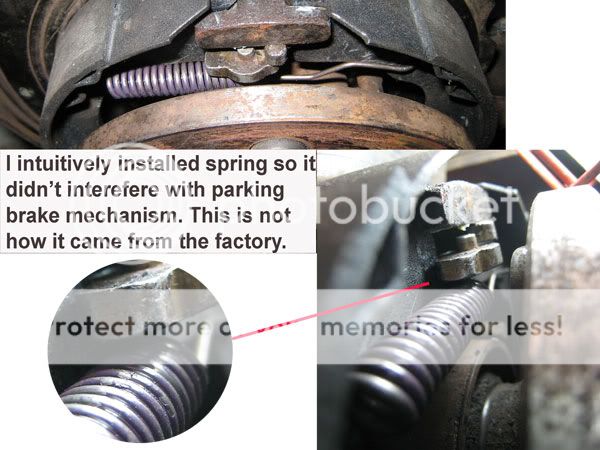
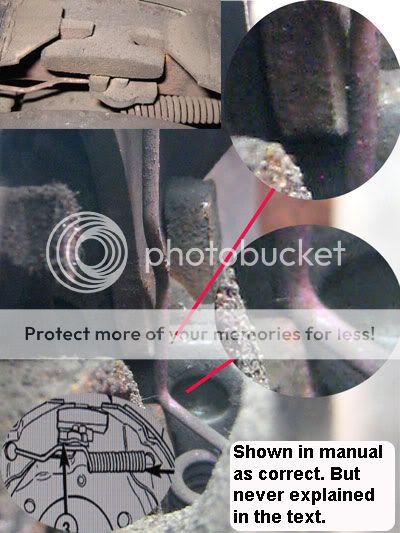
Proper installation of the top shoe brake (parking brake) spring has had me confused during this brake job. (Which is taking FAR too long because of other duties) I consulted the manual after I couldn't see any possible way to install them that made rational sense of the bent area of the spring. The manual does have a drawing, but spring orientation is never mentioned in the text - and the drawing shows it installed opposite my best guess.

While dodging rainstorms, I finally jacked up the whole back axle so I could examine both sides simultaneously. The old side was indeed installed per manual drawing, but it appears to be a flawed design. The photos show both my installation and the factory installation. My installation has the spring clearing all parts. The factory installation has the spring wire extension rubbing up against the parking brake mechanism in two spots - one of which is beginning to carve out a notch in the wire.

I've tried to figure out why on earth they would do this and the only things I can come up with include:
* A support for the parking brake lever.
* Retainer for the parking brake lever. But neither make sense since there is no way that lever mechanism can go anywhere unless it is pulled or the shoes are removed.
* A spring-loaded stop to keep the shoes from drifting up. But this doesn't make much sense either if you closely examine the internal dynamics of the system. And even if it was needed, it seems like a rather silly - if not somewhat dangerous - way of accomplishing the objective.

Does anyone see any reason they would do this? Or is it another one of those "It's a CRD thing, you wouldn't understand"?


Image

Image[/img]

Page 1 of 2 All times are UTC - 5 hours [ DST ]
Powered by phpBB © 2000, 2002, 2005, 2007 phpBB Group
http://www.phpbb.com/