|
Not yet at the end of the road, but going down it - F37 was to reduce engine torque in order to protect the plastic stator and weak TCC clutch
- the torque convertor impeller is driven by the crankshaft - the turbine, connected to the 545 input shaft, is driven by fluid coupling at somewhat less than 1:1 engine torque input - the lower the stall speed the greater the hydraulic coupling - the stator converts 1:1 torque to ~2.1:1 torque when the impeller spins faster than the turbine, which may be stopped as at takeoff, and continues to function until turbine speed matches impeller speed as vehicle speed increases - the stator then freewheels on it's sprag clutch - thus the stator is under considerable strain from dead stopped up thru ~3rd gear, even moreso when towing or during event of rapid acceleration - a turboDiesel engine produces max torque in that range between idle and ~2krpm, most ~1500-1700
- additionally, due to that down-lo torque band, a Diesel engine will slip a TCC that a gasser (patooie!) couldn't possibly slip, as their torque band is up ~3krpm - greater power can be input thru a clutch at high rpm than at low rpm due to inertia - thus the F37 syndrome - therefore the Transgo resistor would likely be death to the oem TC plastic stator, even if it helped some in reducing TCC slip - definitely would not recommend installing the resistor pre-Suncoast - F37 was created to reduce engine power in order to compensate for a weak TC and C
The Export TCM for manual transmissions is not looking for presence or input from a TCM, as is our homeland version - therefore, the TCU from PCS could be utilized to control the 545RFE without alarming the ECM, BCM, SKREEM, etc, in any way - I have looked into that, as well as for my 68RFE for installation into older Dodges as replacement for the 47\48Rx, an early '60's Torqflyte 727 with TCC and tacked-on overdrive
INMOTION is no challenge for the Suncoast Hemi TCC, as installable in our CRD KJ - but, yeah, INMOTION does (over-)compensate for F37
The added Transgo pressure-compensation resistor results in increased line-pressure, which should cause firmer shifts and TCC apply, which it does, for a while - TCM will eventually "learn" to un-compensate, as similar happens when a towed trailer is removed: TCM had increased line pressure to facilitate towing, which then must be reduced to normal when not towing - in that interval the 545 shifts rather firmly for a while as TCM "learns" to reduce pressure
What I noticed, having installed a switch to connect and disconnect the resistor, was that the 2nd-3rd shift was highly disturbing if the resistor was switched-in during normal acceleration event - the other shifting was firmer than normal, but nothing like the 2nd-3rd shift - turns out TCM holds the trans in 1-2-3-4 until after 2-3-4-5 is engaged, to protect the blue-haired granny's dentures - for some reason, 2-3 is worse than the other ranges - the resistor amplifies the hold-release symptom in normal acceleration take-offs, such that the KJ actually slows down during the 2-3 transition if slowly accelerating - it's just a harsher shift when rapidly accelerating - therefore, I switch the resistor out during normal operation, switching it in during testing - never give TCM an even break, I allus sez...................
_________________
'05 CRD Limited
Pricol EGT, Boost
GDE Hot '11; EDGE Trail switched
SEGR; Provent; Magnaflow;
Suncoast T\C, Transgo Tow'n'Go switch;
Cummins LP module, Fleetguard filter, Filterminder
2.5" Daystar f, OME r; Ranchos; K80767's, Al's lifted uppers
Rubicons, 2.55 Goodyears
Four in a row really makes it go
Last edited by gmctd on Tue Mar 03, 2009 12:23 pm, edited 2 times in total.
|

 Login
Login Register
 FAQ
FAQ Search


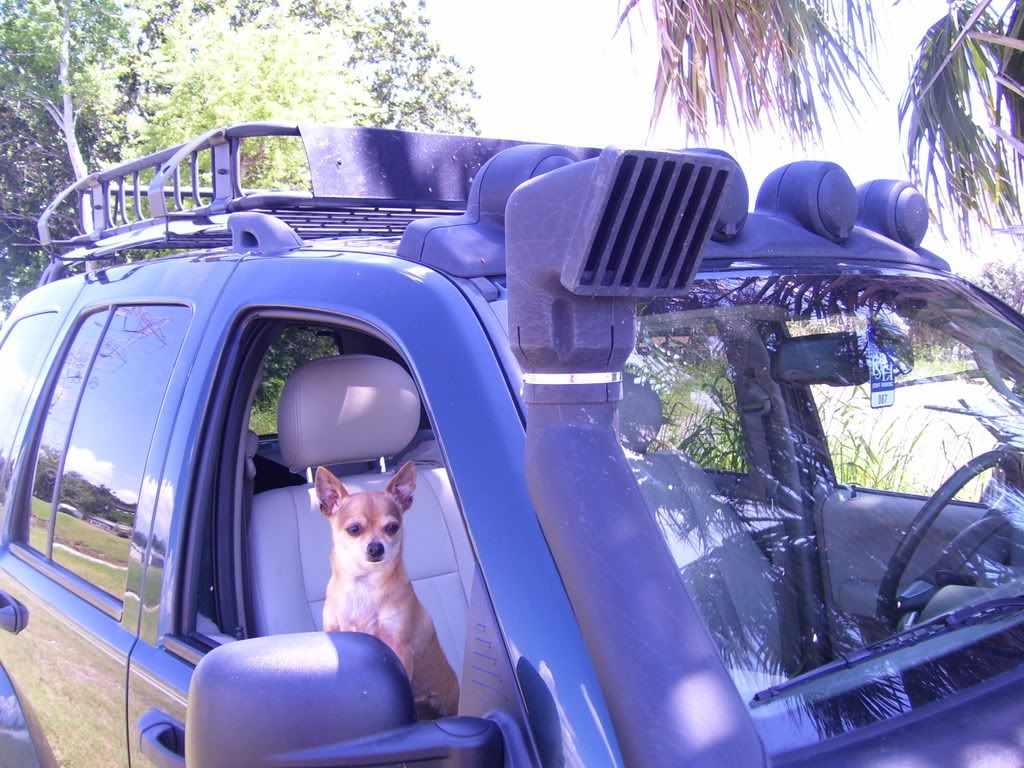


 (with millions of critically-depressed US economy dollars)
  so maybe there is hope...............