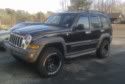
Well after some threads blaming the D30A is to weak to pull anything in reverse has some scared to even put there KJ is reverse.Is the D30A a strong diff? No it is not the
strongest D30 but what it is ment for it is plenty strong.The guy that blew his diff while in reverse was a freak accident,any diff can break and many do at the most inconvenient time possible.
Well lets get to some facts..........
D30A is a
low pinion diff that uses standard cut gears,it is not a high pinion diff.
The D30(TJ's) is a low pinion diff also using standard cut gears.
The high pinion D30 is a high pinion diff(DUH!!!) and uses
reverse cut gears.
Well what does "reverse cut" and "standard cut" gears mean?Here are some stated facts from well known sources,don't mind id the D44 is the reference all the same info applies to all diffs.
Quote:
Reverse-Cut vs. Standard-Cut:
Often mistakenly referred to as "reverse rotation," the term "reverse-cut" is perhaps the single most misunderstood term by four wheelers and even many in the axle business. A reverse cut housing is not just like a standard cut housing turned upside down. It is a specially designed housing for fount driving axles. Contrary to popular belief, it does not turn backwards or in reverse. The term "reverse-cut" actually refers to the direction of the spiral cut in the ring gear.
In a reverse cut axle, the spiral on the ring gear is opposite form a standard -cut ring gear. The idea behind reverse cut is to strengthen the operation of the gear when it is used for a front axle application.

In the early day of four wheel drive, the front axle used the same gears and housing as an ordinary rearend. This was done for economic reasons, since the components were already in mass production. They simply added the necessary parts to enable steering. However, all ring and pinion gears are cut in such a way that they are inherently stronger when pushing the vehicle in the forward direction and weaker when driving in reverse. That means that a standard cut (rearend style) gear, when used in the front, must push on the weaker side of the gear to move the vehicle in a forward direction.
This practice continued until the late 1970s, when Dana designed a new axle that would be stronger for front axle use and also provide better driveline angles for the shorter front driveshafts then being used in new trucks. The reverse cut housing and reverse cut gear set can be identified by the pinion gear, which is located above the centerline of the axle shaft. Therefore, standard cut gears are always strongest when used in rear axles and reverse cut gears are stronger when used in front axles.
Reverse cut axles have also become popular for lifted short wheelbase vehicles like Jeeps, early Broncos and Land Cruisers. The reason is because the higher pinion location greatly reduces rear driveshaft angles. However, not all reverse cut axles are strong enough for use as a rearend. The cut of the gear that makes them stronger for the front axle use also makes them somewhat weaker for the rear axle use. The best and most popular reverse cut axle for rearend use is the Dana 60, a good choice because of its large ring gear diameter, tooth strength, ability to accept 35 spline axle shafts and wide selection of ratios and differentials.
Two other reverse cut axle are the Dana 44 and a new Ford 8.8" reverse cut. The Dana 44 makes an excellent front axle, but just isn't strong enough for rear axle use. The Ford 8.8", reverse cut rearend (new from Currie Enterprises) has a slightly larger ring gear than the 8.5" of the Dana 44 but is not nearly as strong as the Dana 60, which has a 9.75" ring gear. The new 8.8" uses a special third member that bolts into a removable carrier Ford 9 inch housing and its sometimes mistakenly referred to as a reverse cut Ford 9 inch. Both the Dana 44 and the ford 8.8" can accept a maximum of a 30 to 31 spline axle shaft.
The bottom line is that reverse cut gears (front axle style) and axle assemblies are inherently stronger for front axle use because of the way the gear mesh when moving the vehicle forward direction. They also provide better driveline angles because the pinion is located above the centerline of the axle. The gear set used in each type of axle are not interchangeable. Standard cut gears cannot be used in place of reverse cut and vice versa. The housings are also not interchangeable. However, differential cases, be open, limited slip or locker are compatible with both styles, as long as the spline count matches the axle shaft.
-Reverse-Cut vs. Standard-Cut taken from FourWheeler January 1999
And..............
Quote:
Below is the base article that started it all. I was so feed up with all the miss information of the "Web Knowledge" so many people were posting I decided to research it my self. After reading several books from Dana Corp and spending may hours/days on the Dana web page I decided to write a small article to help people avoid the mistakes I made. All though some of the Books are no longer available from Dana the information is still out there. I welcome all and any correction you may have, please see where to contact me on the main page. I'm not the fountain, just a guy who had some drive to do research as in re search and search and search.
This article was written to document the early years of Dana 44 Reverse Spiral Solid front axle. It also includes information on the regular Dana 44 axle to compare the two, it is even expending into some Dana 60 info. It will concentrate on the Ford front straight axle from the mid 60's and several other axles. Additionally this article should dispel some of the myths about the first front drive axle that Dana / Spicer built with a Reverse Spiral Gear Set. The Dana 44 Reverse Spiral axle will be refereed to as the Dana 44RS within this article.
Dana designed the first reverse spiral axle in the early sixties for Ford. Dana released the 44RS for production in January 1965. Early enough to possibly be under a few rare 1965 F100's, however no written confirmation on this has been found. The 44RS was a complete new design in axle, with special design to lube the pinion that was above the fluid level. This axle has also been called the Dana 44 High Pinion, Dana 44 Reverse Rotation, Dana 44 Reverse Cut, Dana 44 High clearance and many more names. A reverse spiral axle has the center line of the pinion contacting the ring gear above the center line of the axle, and thus has different lubrication passages. This axle offers a strength increase over a standard rotation axle while in forward movement. It allows the drive shaft to contact the pinion yoke at a much higher level of connection, thus keeping the drive shaft several inches higher. The gears are not interchangeable with gear sets that are designed with the pinion below the centerline of the ring gear, however the carrier is. Reverse Cut refers to the direction the ring gear is cut for reverse spiral housing. The axiom of the reverse cut is to strengthen the gear while in the front drive axle of operation. Standard cut gears can not be swapped with reverse cut gears, however in the Dana 44 the ring gear carrier can be swapped. High pinion, Hy-Pinion or Hi-Pinion are all slang used in and out of the industry for a reverse spiral axle. High Clearance is a Ford marketing term used for the reverse spiral axle. Reverse rotation: is the single most misused axle term. Reverse Rotation is a slang term used to describe a reverse spiral cut housing. Neither the axle nor the axle shafts travel in a reverse motion, or travel 'backwards' compared to a regular housing. This term only shows the ignorance of the person or company using it.
Well with that info a "low pinion/standard cut" front diff actually is stronger when in reverse compared to a "high pinion/reverse cut" front diff.The alloy housing is the main concern with the D30A but do not worry,learn from others mistakes and you will make the D30A survive.I have pulled F250's out of deep mud in reverse,no issues,have also pulled many of obstacles with no issues.You also got to look at the size of the vehicle you are trying to recover,you have a higher risk for breaking something pulling a 3/4ton pickup out with your KJ then say a TJ,that is just common sense.
Now some more fun facts................
The '02 and some early '03 KJ's have the 45RFE,and to include the CRD's 545RFE's also..........
1st gear is 3:1
Reverse is 3:1
'03+ KJ's/KK's with the 42RLE transmission..............
1st gear is 2.84:1
Reverse is 2.21:1
So basically the 45RFE/545RFE equipped KJ's have more low end grunt in forward and reverse then a 42RLE equipped KJ/KK.Keep that in mind when you hook up to recover next time.
Now will come the "But this,But that" comments,you should do this,should do this comments.Be it as may be any diff,and I mean any diff can and will break.The D30A breaking is not a common issue,there has been what 10 reported here on L.O.S.T.? Sure that's out of a small # of KJ's but with 1.2million+ KJ's built if 1000 front diffs exploded that still would be far below a "common" issue.Look at other vehicles,how many D35's have blown apart in TJ's? I don't have accurate #'s but over 100,000+ would be a lowball estimate inj my opinion.Read at own risk and take the info for what it is worth.

 Login
Login Register
 FAQ
FAQ Search



 .
.