It is currently Mon Jan 12, 2026 5:02 am

All times are UTC - 5 hours [ DST ]


Post new topic Reply to topic  [ 66 posts ]  Go to page Previous  1, 2, 3, 4  Next
Author Message
 Post subject: Re: why so many crd throw rods?
PostPosted: Wed Jan 23, 2013 12:11 am 
Offline
LOST Addict
User avatar

Joined: Thu Sep 06, 2007 9:51 pm
Posts: 6302
Location: Somewhere between Heaven and Hell... But it is really hot here on Earth...
crd260 wrote:
whoa...

you're a gear head and you've got 2 blown motors with EGR deleted, eh?
huh... that's a stumper....
let's see... what's in common with those 2 motors.....
- The driver : you bag on this thing or what?
- The turbo: did you re-use the same turbo by chance..... ever look into how much pressure is dropping across it?
- The Trans,flex plate and TC... not sure how it could be the cause..... but.. hey it's most likely a common link (unless you changed those too)......
what about the oil cooler? did you swap it out with the motor?
And when you said you "blocked off" the EGR.. you mean you physically blocked off the pipes? Keith @ GDE and I Talked about this, and he suggested it was a bad idea.... even with the ECO tune, the EGR valve is used as a waste-gate to prevent turbo surging...... Disabling the EGR that way would wear the thrust bearing in the turbo pretty quick (at least in theory).... What's the side to side movement like in you're turbocharger?
if your thrust bearing is worn, and you re-used the turbo on both motors (or the thrust bearing on both turbo's was bad) you may have found your problem....


Let me answer all of this, obviously you haven't seen the depth of my posts here... I've been around a lot, and I am no longer slave to one of these Italian dominatrixes.

I do not bludgeon or flog my vehicles (any more). I did when I was younger, but that was a previous vehicle. A 2001 VW Jetta TDI that I flogged for 150k miles, and it kept coming back for more. There are many stories about things I shouldn't have done with that car, but this isn't that vehicle.

I drive about 50k miles per year. Since I bought a new vehicle (2003 VW Jetta TDI - b/c it was so reliable) in October, I have put almost 12k miles on it... And will be doing another 3k before February 5th has passed. I want RELIABILITY above all else. I ask that from my vehicles, and performance that is well within the capabilities.

I towed with my CRD, as much as 7000 lbs (not long distance), and 4000 lbs (3k miles) but total time towing is easily less than 3% of the total mileage. I don't shut the engine off when I'm towing and just stopping for fuel / restroom... I wouldn't want the turbo to overheat.

I use gauges. Oil pressure, boost, EGT. The first engine failure rapidly followed a turbo failure - ON A STOCK F37 TUNE, which was Chrysler's answer to the weak torque converter: de-tune the engine. It didn't help. Failure #1 could easily have been from low oil pressure after the turbo snapped.

The replacement engine came with a replacement turbo, the brand-new turbo (with a factory VNT defect) went on the shelf. Engine #2 lost its turbo at about 116k miles, but not catastrophically. The turbo began making noise, and I pulled it from service immediately and replaced it with bad-VNT-turbo... Until I was able to construct a working turbo of good-center-section from the new turbo, and good VNT from the noisy turbo. All right with the world, and it never ran low on oil or had an oil leak.

The transmission is as much a commonality in the engine failures, as the tires or taillights are. Same for the oil cooler. That is a metal box with air holes and oil holes. It doesn't need to be replaced, and wasn't. Same for the cooling system or the AC. BOTH engine failures were the bottom end. Unrelated parts are unrelated.

As far as Keith's thoughts on the EGR acting as a "wastegate" function... I've had that conversation with him too, and I have my thoughts and he has his. I respectfully disagree, and the "turbo bark" that he says is a possible result of blocking those pipes is both not present, and I firmly believe impossible with this design. There is a longer thought experiment I posted somewhere about this recently, but the short version is this: To have turbo 'bark' and shaft reversal, the airflow under pressure has to rapidly cease flowing into the engine. On a GAS turbocharged engine, there is a throttle flap that slams shut when you drop off the gas pedal. This could easily cause a pressure backwash in the intake, as the pressure tries to escape out the intake, reversing the turbo.

We don't have that.

Oh, but you point at the FCV flap? The one that my engine doesn't have? The one that I unplugged, even after it had stripped its own plastic gears (in just about every CRD, yours included)? Yea... That isn't a throttle flap - diesels don't have those. That is ONLY part of the EGR system, to force even more EGR flow by the computer.

The final nail in the turbo bark problem: The turbo compressor wheel is a standard threaded part, onto that shaft. If the wheel WAS violently forced from 50k rpm in one direction to stop and reverse... How long do you think it would remain threaded onto its shaft? It would unscrew and hit the housing QUITE quickly. Since we don't hear of this happening, and it doesn't take a gorilla to unscrew the wheel yourself... This is not happening, and blocking those pipes has no negative effects... Or at least not that one.

I'd love to find out the answer to this, I strongly suspect that it is a design flaw. Especially when I was meticulous to the point of silly trying to prevent the engine from failure a second time. Had I not been listening carefully and heard the turbo noise, it is entirely possible that I might have lost engine #2 the same way, from a turbo failure. I do think it is related to the oil, but I haven't figured out how yet... To any conclusive and logical degree.

_________________
Proud supporting vendor of LOST Jeeps
TRAVELING CRD TECH. I come to you!
Need help? Just ask! I've taken it apart more than most.
Email jeep [at] maincomputer [dot] com - BOARD MESSAGING IS BROKEN
Over 225 CRDs currently driving with my valves, timing belt, rockers, or ARP Studs.
Bad noises = REALLY bad things.


Top
 Profile  
 
 Post subject: Re: why so many crd throw rods?
PostPosted: Wed Jan 23, 2013 1:56 am 
Offline
LOST Member

Joined: Mon Oct 29, 2012 2:28 pm
Posts: 103
Hmmmm

a LOT Of the ford guys talk about surging, and talk about their EGR systems acting as waste-gates....

not to mention... keith is programming these ECU's... he can SEE the waste-gate code.....

http://www.thedieselstop.com/forums/f25/turbo-surge-66431/

Quote:
The 6.4L engine was designed to use EGR as a wastegate of sorts and has 25% EGR flow at max power. For peak performance EGR is not desired and with many tuning programs the EGR is turned off. With the EGR turned off the exhaust backpressure jumps to overly high levels resulting in lost power and un-needed stress on engine components.


http://www.rudysdiesel.com/_e/EGR_Delete_Kits/product/64-EGR/Elite_Diesel_EGR_Delete_With_Wastegate.htm

http://www.dieseltruckresource.com/dev/turbo-surge-t215490.html


Think about it this way:

Your exhaust manifold has some volume... think of that volume like the air tank on an air compressor..... you can turn your compressor off, but it would take some time to drain the tank if your only using a little bit of air....

The pistons are constantly pumping hot exhaust gases into the manifold.... this gets forced through the turbine housing of the turbo charger, and causes the the turbo to spin......

When you give the engine "gas" your pumping lots of hot exhaust gases into the manifold....
When you take your foot off the gas, the gases don't simply disappear, they take time to vent through the relatively small turbine housing..

Now the turbocharger has a built in waste gate, but because of the way it's plumbed, it only opens when the intake pressure reaches a certain level.....

now... you mentioned you removed the throttle plate, and your saying that because a gas motor has a throttle body, the abrupt closing of the throttle body can cause surging because the air in the plenum / inter-cooler has nowhere to go.....

But what your failing to take into consideration is this:

Turbo lag works both ways: The turbo takes a times to spin up (build pressure in the exhaust manifold) and it takes time to spin down (release manifold pressure through the relatively small compressor housing / wheel)
When a transmission up shifts, and RPMS drop abruptly, an engine "pumps" way less air......

So your going up a hill, your at 3500 rpms, your exhaust manifold is at 200 PSI, cramming exhaust through your turbine

Your intake manifold is at 30PSI (guessing, never actually checked) and at 3500 RPMS, she's going though the air just fine.

Then you take your foot off the gas... your transmission up-shifts, your rpms drop to 1,200.....

this is where the EGR valve would open, and vent of some of the exhaust manifold pressure...

but you've blocked the system off, so instead of the manifold pressure dropping when you took your foot of the throttle, the pressure stays high....

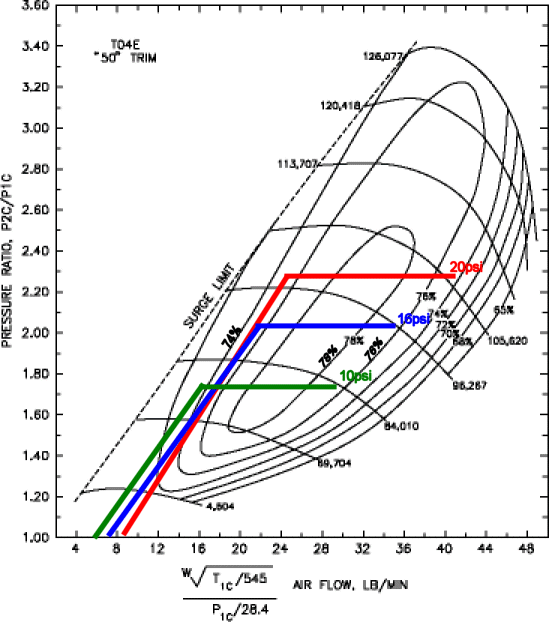
With your intake manifold already pressurized but the engine no longer pumping air at a higher speed, your "pressure to flow" ratio of your turbo goes off the map. (this isn't a map for our turbo's I'm sure you can google it)
Image

if you look at the turbo map, you will realize the problem.....

the turbos can generate a range of pressure ratios, and a range of flow, but the two have to cross somewhere on the map....

for example (Random numbers but just for argument's sake)
It can make 30PSI, but only between 200 and 500 CFM..... if you try to make 30PSI at 100CFM, your compressor will surge....

The manifold's main waste gate only opens to keep the intake manifold PRESSURE consistent... it's a spring and a diaphragm connected to your intake manifold.... The main waste gate has no idea whatsoever what the FLOW is through the engine......

look at this post from a dodge cummins forum:

Quote:
Since my new T/C was installed I've noticed more "Bark" in my turbo. When the T/C locks during the 3/4 shift it sometimes causes the turbo to bark. Is there anything I can do to prevent this besides letting off the throttle during the shift.

http://www.dieseltruckresource.com/dev/turbo-surge-t215490p2.html

He's talking about his turbo surging when his transmission goes from 3rd to 4th gear....

Lower engine RPMS = reduced air flow through the engine.....

Remember, we have variable vane turbos too... they are likely much more sensitive to surging.....

You deleted 2 EGR systems and blew 2 turbos..... I don't think it's a coincidence....

but then I Could be wrong....

here is more info for you directly from Garrett's website

http://www.turbobygarrett.com/turbobygarrett/surge_line

Quote:
Surge is the left hand boundary of the compressor map. Operation to the left of this line represents a region of flow instability. This region is characterized by mild flutter to wildly fluctuating boost and “barking” from the compressor. Continued operation within this region can lead to premature turbo failure due to heavy thrust loading.
Surge is most commonly experienced when one of two situations exist. The first and most damaging is surge under load. It can be an indication that your compressor is too large. Surge is also commonly experienced when the throttle is quickly closed after boosting. This occurs because mass flow is drastically reduced as the throttle is closed, but the turbo is still spinning and generating boost. This immediately drives the operating point to the far left of the compressor map, right into surge.

Surge will decay once the turbo speed finally slows enough to reduce the boost and move the operating point back into the stable region. This situation is commonly addressed by using a Blow-Off Valves (BOV) or bypass valve. A BOV functions to vent intake pressure to atmosphere so that the mass flow ramps down smoothly, keeping the compressor out of surge. In the case of a recirculating bypass valve, the airflow is recirculated back to the compressor inlet.


Image

Quote:
On a GAS turbocharged engine, there is a throttle flap that slams shut when you drop off the gas pedal. This could easily cause a pressure backwash in the intake, as the pressure tries to escape out the intake, reversing the turbo.


Your assuming that surging is only possible when air flow goes "backwards" through the compressor side of the turbo.... this is not the case...


The science of gases and liquids going over surfaces at high speeds is very complex...

Think of a boat's prop in water, now think of a boats prop cavitating.... little vortexes of vacuum at various points on the propeller... Doesn't sound like a big deal, but it's as if someone put your boat in neutral and you can't "grab" the water......

When your compressor wheel tries to spin, and force the air past it at a certain pressure, it can only do this in a certain "window" of flow... if you go too far to the left on that window (compressor map), the gases (in this case air) do strange things around the compressor wheel.... This causes all kinds of strange forces on the turbo's rotating assembly..... not just "Trying to turn the compressor wheel backwards, which would in turn unscrew it because it's threaded on a certain way"... it also forces it sideways which puts a bunch of load on the thrust bearing, and in extreme cases it can cause violent changes in loading that can break shafts and fins.....


Top
 Profile  
 
 Post subject: why so many crd throw rods?
PostPosted: Wed Jan 23, 2013 11:31 am 
Offline
LOST Addict
User avatar

Joined: Thu Sep 06, 2007 9:51 pm
Posts: 6302
Location: Somewhere between Heaven and Hell... But it is really hot here on Earth...
So much of what you posted has zero to do with our turbo and intakes, and I can't reply to it all on a phone.

We do not have any waste gate or manifold vents. Turbo back pressure is released instantly past the turbo when the vanes open, and at no point will "300 psi" in the exhaust vent ANYWHERE beneficial if the egr opens into a 25 psi intake. High pressure flows to low pressure, always. Thus, opening the egr into the intake will make the problem WORSE in the example you site of "low rpm and lower airflow" because that exhaust pressure would force its way onto the air filter to escape.

It does not work that way, that WOULD cause bark and turbo death.

The lack of a waste gate is not a mistake - the VNT is the waste gate for our tiny turbo, and if a giant ford turbo has both, it is because the total airflow is so much greater than ours is capable of. Attempt to connect what you like, but this is not a turbo problem no matter what. It is a bottom end problem.

_________________
Proud supporting vendor of LOST Jeeps
TRAVELING CRD TECH. I come to you!
Need help? Just ask! I've taken it apart more than most.
Email jeep [at] maincomputer [dot] com - BOARD MESSAGING IS BROKEN
Over 225 CRDs currently driving with my valves, timing belt, rockers, or ARP Studs.
Bad noises = REALLY bad things.


Top
 Profile  
 
 Post subject: Re: why so many crd throw rods?
PostPosted: Wed Jan 23, 2013 12:12 pm 
Offline
LOST Member

Joined: Mon Oct 29, 2012 2:28 pm
Posts: 103
geordi wrote:
So much of what you posted has zero to do with our turbo and intakes, and I can't reply to it all on a phone.

We do not have any waste gate or manifold vents. Turbo back pressure is released instantly past the turbo when the vanes open, and at no point will "300 psi" in the exhaust vent ANYWHERE beneficial if the egr opens into a 25 psi intake. High pressure flows to low pressure, always. Thus, opening the egr into the intake will make the problem WORSE in the example you site of "low rpm and lower airflow" because that exhaust pressure would force its way onto the air filter to escape.


You still don't understand WHAT surging is:

Yes, there is a type of surging where the intake charge goes backward through the compressor side of the turbo-charger.

But that is NOT the type of surging we're dealing with here.

If you look at a turbocharger's compressor map, there are 4 things.... flow, pressure, rpms and efficiency.

if you try to make pressure WITHOUT flow, the compressor surges... period

The variable vane in our turbos are not setup to deal with reduced flow through the engine...

So what's destroying your turbochargers is not the intake charge going backwards through the compressor side, it's the side effects of the compressor wheel dealing with the fluid dynamics of trying to generate high pressure with too low of flow... Weird stuff can happen to the compressor wheel... vortexes of vacuum, over revving of the turbo, etc...


Quote:
It does not work that way, that WOULD cause bark and turbo death.


Your saying here that venting the high pressure exhaust manifold into the intake manifold would make the problem worse. Again, your still thinking of the "air going backwards through the turbo" type of surging... We're dealing with the "the compressor wheel is trying to create too much pressure with not enough flow" type of surging. The turbo is basically spinning too fast for the amount of air flow going through it...

yes, opening the EGR valve at this point WOULD increase the pressure of the intake manifold (but do the quick math volume wise: volume of exhaust manifold vs volume of intake manifold + intake plenum + intercooler) : the increase in intake manifold pressure would be a drop in the bucket compared to the drop of exhaust manifold pressure.

The quick drop in exhaust manifold pressure is enough to slow the turbo down enough to prevent surging.


Quote:
Turbo back pressure is released instantly past the turbo when the vanes open


I'm not sure on this one, I haven't looked into our VNT system that much, but I'm willing to bet there is no mechanism to actuate the vanes in this situation..... as far as I know, the vanes only move during turbo spin up, and once the manifold pressure has reached the desired boost..


Quote:
Attempt to connect what you like, but this is not a turbo problem no matter what. It is a bottom end problem.


Listen..... forums like these are for people to come together and help solve problems..... not get into pissing matches.....
so when I say what I'm about to say, please understand that I'm not trying to be a jerk, just make a few points....

#1. Keith (the guy who has 2 active posts giving him kudos at the moment) knows enough about the code in these things to make custom tunes on the fly. If he tells me there is code in there to use the EGR as a waste gate to prevent turbo's from blowing up, I tend to believe him

#2. again, don't mean to sound like a jerk.... you're 2 for 2 on EGR block-offs, and 0 for 2 on turbos lasting..... that's a pretty profound statistic.... there are lots of us on the forums with more miles than you who's turbos have NOT blown....... think about it......


Top
 Profile  
 
 Post subject: why so many crd throw rods?
PostPosted: Wed Jan 23, 2013 12:31 pm 
Offline
LOST Addict
User avatar

Joined: Thu Sep 06, 2007 9:51 pm
Posts: 6302
Location: Somewhere between Heaven and Hell... But it is really hot here on Earth...
And the number of people who have lost the turbo far exceeds your limited sample of just me. Try at least 4 that I've read about in just the last 3 months or so. The correlation you seek does not exist.

_________________
Proud supporting vendor of LOST Jeeps
TRAVELING CRD TECH. I come to you!
Need help? Just ask! I've taken it apart more than most.
Email jeep [at] maincomputer [dot] com - BOARD MESSAGING IS BROKEN
Over 225 CRDs currently driving with my valves, timing belt, rockers, or ARP Studs.
Bad noises = REALLY bad things.


Top
 Profile  
 
 Post subject: Re: why so many crd throw rods?
PostPosted: Wed Jan 23, 2013 12:38 pm 
Offline
LOST Junkie

Joined: Tue May 29, 2012 8:45 am
Posts: 908
Location: Western, PA
Mabe we need a new post on turbochargers. This one is heating up! :POPCORN:

_________________
05 Liberty CRD Sport with Leather 115k
GDE ECO, No EGR, no FCV, (system gone)
Oil Drain plug P/N 090-039
K&N Air Filter, 2nd gen Fuel filter head
NEW Rockers & lifters
Mobil 1 0w-40
Stant 13519 195 deg inline Thermostat.
0 281 002 845 MAP
Etecno GX3123 7v Glow Plugs
Advance Gold 800CCA Battery
Traded it for a Quality VW TDI


Top
 Profile  
 
 Post subject: Re: why so many crd throw rods?
PostPosted: Wed Jan 23, 2013 1:00 pm 
Offline
LOST Junkie

Joined: Sun Dec 18, 2011 1:15 pm
Posts: 776
Location: Eastern US
Here is my take on this:

Turbo surge can be momentary overpressurization of the supply side caused by rapid reduction in intake volume at the engine. For a very short time period, the intake boost pressure can significantly exceed design specs, and even exceed exhaust pressure. The VVT actuator would not have sufficient time to affect the vane position to prevent this pressure pulse.
If the EGR pipe was blocked, either by soot or by intent, then there would be no outlet for the air except through the engine, which would subject the motor to momentary pressures well in excess of design spec. This could cause peening of the rod bearings and/or main bearing, leading to stretching of the rod bolts, all of which could result in excess bearing clearance, leading down the path to lower end failure.

Now, I am *not* saying that this is in fact what happened to Geordi's motors, but it is one possible explanation. I would love to know which came first, rod bolt stretch or bearing failure, but in any case there are other hypotheses. We already know that VM Motori made a poor choice of head bolt, and it is possible that they did something similar on the rod bolts, but I do not have enough data to render an opinion on this issue yet. In the interim, however, I will retain the EGR system as a waste gate to protect against such overpressures.

Anybody

_________________
Grid power- the one true essential

2005 Liberty CRD- ARP studs, Fumoto, Hayden FC, inline Tstat, ETechno 7v GP, Platinum P1, in-tank lift pump.
1983 Volvo D24T
1981 Volvo D24
Dodge Cummins TD
Case 580B
Mitsubishi MT180 diesel
Kubota BX25 diesel


Top
 Profile  
 
 Post subject: Re: why so many crd throw rods?
PostPosted: Wed Jan 23, 2013 1:07 pm 
Offline
LOST Junkie

Joined: Sun Dec 18, 2011 1:15 pm
Posts: 776
Location: Eastern US
geordi wrote:
And the number of people who have lost the turbo far exceeds your limited sample of just me. Try at least 4 that I've read about in just the last 3 months or so. The correlation you seek does not exist.


turbo failure has all sorts of possible causes, starting with excess soot, lack of cooldown, etc. It is very hard in such a situation to single out one proximate factor, so I would suggest that we focus on learning as much as possible from the evidence given by the lower end.

_________________
Grid power- the one true essential

2005 Liberty CRD- ARP studs, Fumoto, Hayden FC, inline Tstat, ETechno 7v GP, Platinum P1, in-tank lift pump.
1983 Volvo D24T
1981 Volvo D24
Dodge Cummins TD
Case 580B
Mitsubishi MT180 diesel
Kubota BX25 diesel


Top
 Profile  
 
 Post subject: Re: why so many crd throw rods?
PostPosted: Wed Jan 23, 2013 2:28 pm 
Offline
LOST Junkie

Joined: Tue May 29, 2012 8:45 am
Posts: 908
Location: Western, PA
My take....
1. Having the EGR caped or blocked will have no negitive effect on the rods or bearings.
2. Having the EGR caped or blocked will have little to no damaging effect to the Turbo. It may effect the turbo, but damage? Im sure if you have a turbo tune it will effect it more?

Just my take

_________________
05 Liberty CRD Sport with Leather 115k
GDE ECO, No EGR, no FCV, (system gone)
Oil Drain plug P/N 090-039
K&N Air Filter, 2nd gen Fuel filter head
NEW Rockers & lifters
Mobil 1 0w-40
Stant 13519 195 deg inline Thermostat.
0 281 002 845 MAP
Etecno GX3123 7v Glow Plugs
Advance Gold 800CCA Battery
Traded it for a Quality VW TDI


Top
 Profile  
 
 Post subject: Re: why so many crd throw rods?
PostPosted: Wed Jan 23, 2013 3:36 pm 
Offline
LOST Addict

Joined: Fri Jun 22, 2007 11:43 am
Posts: 4962
Location: Green Cove Springs FL
LMWatBullRun wrote:
Here is my take on this:

.
If the EGR pipe was blocked, either by soot or by intent, then there would be no outlet for the air except through the engine, which would subject the motor to momentary pressures well in excess of design spec. This could cause peening of the rod bearings and/or main bearing, leading to stretching of the rod bolts, all of which could result in excess bearing clearance, leading down the path to lower end failure.


IF there is excessive pressure in the intake (from the turbo) the pistons/rods will only feel that
on the intake stroke when the piston is already traveling down. Now, do you really think that
any excess pressure at this point would be greater than the pressures felt during the compression
stroke?

Connecting rod/bolt stretch?
This is usually only a problem during rapid engine deceleration.
Even more a problem with gasoline engines that use a throttle plate.
Rapid crankshaft deceleration + closed throttle plate = high vacuum = potential for rod/bolt stretch.
Our diesel engines do not have a throttle plate and therefore produce no vacuum.
Connecting rod bolt stretch is still a possible problem but...
Correctly installed and torqued rod bolts SHOULD be pre-stretched.
They make tools for measuring rod bolt stretch prior to final engine assembly. Professional
engine builders will use these to determine accurate and proper rod bolt torque.
Now, i realize that VM is not measuring each and every set of connecting rod bolts but whoever
is making those bolts will do the measurement and specify proper torque to VM.

_________________
U.S. Army Retired


Top
 Profile  
 
 Post subject: Re: why so many crd throw rods?
PostPosted: Wed Jan 23, 2013 5:11 pm 
Offline
LOST Addict

Joined: Thu Oct 20, 2005 5:42 am
Posts: 2122
Location: Fort Collins, CO
kjjet wrote:
My take....
1. Having the EGR caped or blocked will have no negitive effect on the rods or bearings.
2. Having the EGR caped or blocked will have little to no damaging effect to the Turbo. It may effect the turbo, but damage? Im sure if you have a turbo tune it will effect it more?

Just my take

I'm with you. If you don't constantly drive your CRD like a racecar, banging redline shifts and yanking your foot out of of the go pedal at full boost, plating off your egr shouldn't damage anything.

_________________
05CRD: GDE Hot ECU & TCM tunes, Provent, Cat filter, Facet lift pump, TransGo kit, Florida TC, Samcos, stainless brake lines, HDS thermostat, Renegade light bar,
Bilstein adjustables, Al's Gen 4.5 Arms, 235/85-16 Duratracs, DTT rear, Elocker front, EVIC+TPMS, Turbo timer, McNally pillar gauges, Weeks Stage II kit.


Top
 Profile  
 
 Post subject: Re: why so many crd throw rods?
PostPosted: Wed Jan 23, 2013 7:38 pm 
Offline
LOST Newbie

Joined: Fri Jan 11, 2013 7:38 pm
Posts: 50
The 2.5 VM engine as fitted to the TX4 Taxi I own and the Maxus van both have issues with the bottom end.

General co census is if you get past 130k you are going to get decent life out of it, apparently!

Not a fan of the opinion that 0w40 oil is breaking these engines, as that would infer Full Synth like Mobil 1 being used.

I suspect it has more to do with use of semi synth oil over 10k mile oci for 80, 90, 100k.

Some have been know to out conventional oil.

I will admit my 2.5 VM ran really nice on Maxlife diesel 10w40 synth blend but the recent fill of Mobil 1 New Life has certainly made a difference. When driving at a steady 70mph it felt real smooth. That is a fairly significant speed for a TX4.

It looks like I won't get to find out how many miles good maintenance will get out of the engine as I have 3 offers on the table to buy it off me at a price point difficult to pass up.

I might try to find an early manual 2.5 CRD Cherokee (Liberty) to drive.

If you look at the service manual it certainly isn't a run of the mill bottom end design.


Top
 Profile  
 
 Post subject: Re: why so many crd throw rods?
PostPosted: Wed Jan 23, 2013 8:17 pm 
Offline
LOST Junkie

Joined: Tue May 29, 2012 8:45 am
Posts: 908
Location: Western, PA
The turbo is not the reason for rod failures! See below post by GDE.

viewtopic.php?f=5&t=73865&p=772536#p772536

_________________
05 Liberty CRD Sport with Leather 115k
GDE ECO, No EGR, no FCV, (system gone)
Oil Drain plug P/N 090-039
K&N Air Filter, 2nd gen Fuel filter head
NEW Rockers & lifters
Mobil 1 0w-40
Stant 13519 195 deg inline Thermostat.
0 281 002 845 MAP
Etecno GX3123 7v Glow Plugs
Advance Gold 800CCA Battery
Traded it for a Quality VW TDI


Top
 Profile  
 
 Post subject: Re: why so many crd throw rods?
PostPosted: Wed Jan 23, 2013 9:34 pm 
Offline
Lifetime Member
Lifetime Member
User avatar

Joined: Thu Dec 29, 2005 9:59 pm
Posts: 5171
Location: Austin, TX
There have been several folks mentioning that they blocked the EGR - it's common in areas that don't have annual inspections.
they haven't come back and said they've blown engines.

definitely not cause and effect
secondary interaction maybe? - who knows - not enough data.

_________________
2005 CRD
stuff
Skeptic quod gratis asseritur, gratis negatur


Top
 Profile  
 
 Post subject: Re: why so many crd throw rods?
PostPosted: Thu Jan 24, 2013 10:07 am 
Offline
LOST Junkie

Joined: Sun Dec 18, 2011 1:15 pm
Posts: 776
Location: Eastern US
flash7210 wrote:
LMWatBullRun wrote:
Here is my take on this:

.
If the EGR pipe was blocked, either by soot or by intent, then there would be no outlet for the air except through the engine, which would subject the motor to momentary pressures well in excess of design spec. This could cause peening of the rod bearings and/or main bearing, leading to stretching of the rod bolts, all of which could result in excess bearing clearance, leading down the path to lower end failure.


IF there is excessive pressure in the intake (from the turbo) the pistons/rods will only feel that
on the intake stroke when the piston is already traveling down. Now, do you really think that
any excess pressure at this point would be greater than the pressures felt during the compression
stroke?


It will increase the pressure imposed during the compression stroke and especially during the ignition/combustion stroke. Significantly.

flash7210 wrote:
Connecting rod/bolt stretch?
This is usually only a problem during rapid engine deceleration.


significant increase in combustion pressure results in increased piston velocity both ways.
at higher RPM, this *could* result in rod bolt stretch.

flash7210 wrote:
Connecting rod bolt stretch is still a possible problem but...
Correctly installed and torqued rod bolts SHOULD be pre-stretched.
They make tools for measuring rod bolt stretch prior to final engine assembly. Professional
engine builders will use these to determine accurate and proper rod bolt torque.
Now, i realize that VM is not measuring each and every set of connecting rod bolts but whoever
is making those bolts will do the measurement and specify proper torque to VM.


What should happen and what does are different things. We have already seen that VM Motori cannot reliably produce effective clamping on the head 100.0% of the time with the "TTY" head bolts, which does make me wonder whether they were riding on the edge with the rod bolts. If they were right on the edge of what the rod bolts would take, additional stresses on these bolts or even some stochastic variation in the install could cause problems in the bottom end. So we are back to the question of which went first, bearings or bolts? Bearings could get excessive play from peening or from wear, so there are several failure mechanisms that come to mind. More data would be useful.

_________________
Grid power- the one true essential

2005 Liberty CRD- ARP studs, Fumoto, Hayden FC, inline Tstat, ETechno 7v GP, Platinum P1, in-tank lift pump.
1983 Volvo D24T
1981 Volvo D24
Dodge Cummins TD
Case 580B
Mitsubishi MT180 diesel
Kubota BX25 diesel


Top
 Profile  
 
 Post subject: Re: why so many crd throw rods?
PostPosted: Thu Jan 24, 2013 10:09 am 
Offline
LOST Junkie

Joined: Sun Dec 18, 2011 1:15 pm
Posts: 776
Location: Eastern US
ATXKJ wrote:
There have been several folks mentioning that they blocked the EGR - it's common in areas that don't have annual inspections.
they haven't come back and said they've blown engines.

definitely not cause and effect
secondary interaction maybe? - who knows - not enough data.


Agreed. More data would be very useful.

_________________
Grid power- the one true essential

2005 Liberty CRD- ARP studs, Fumoto, Hayden FC, inline Tstat, ETechno 7v GP, Platinum P1, in-tank lift pump.
1983 Volvo D24T
1981 Volvo D24
Dodge Cummins TD
Case 580B
Mitsubishi MT180 diesel
Kubota BX25 diesel


Top
 Profile  
 
 Post subject: Re: why so many crd throw rods?
PostPosted: Thu Jan 24, 2013 10:42 am 
Offline
LOST Newbie

Joined: Fri Jan 11, 2013 7:38 pm
Posts: 50
One comment regarding the EGR valve.

The one fitted to the 2.5 VM currently in the TX4 since 2006 is very different to the one fitted to either the 2.5 or 2.8 Jeep Cherokee in the UK I assume that as the UK models are made in the same factory that they will be the same as the US 2.8.

None of the VM lumps in the TX4 have had the EGR blocked due to strict inspections by the Taxi licensing authority.

There is also a school of thought that treatment is relevant. Mine has been worked by two drivers, both plodders.

But in a small social group of 10/12 drivers two have had bottom end failures, under 100k. And two of them have the older non VM engined vehicle.

A friend had me buy a 2.5 manual CRD Cherokee (2002) for her which was shipped Africa. It went to Tanzania and was driven cross country to Zimbabwe, where it is now. That had 115k on it six months ago when it was bought.

I did try an convince her to make sure it got its oil and filter changed regularly and it had the cambelt done at 90k according to the comprehensive history.

I am sure I will be asked to find parts for it if the engine goes and I will post up when it does, he has already been asking for a cambelt kit and injector seals for some reason, but not oil filters or oil!

Is the engine more suited to a manual box perhaps?

There is a private ambulance company still using VM engined Maxus Ambulances but for normal patient transport, no fast or emergency work and they all have high miles.

But many vans of the same make and engine appear on eBay with bottom end problems.

Which brings me back to how they are treated along with good maintenance with fuy synth oil.

JustTaxis near London is a well established Taxi garage that was one of the first that I know that went to full synth only on the VM engined vehicles and they have had no engine failures in the vehicles they maintain, I couldn't justify continuing to use them for routine maintenance but they do the big stuff like cambelts.

Apart from a couple of short intervals on semi synth and one on synth blend Maxlife diesel mine has mainly been given full synth.

Of the engines failing how many have sketchy history or are likely to have been given dino oil?


Top
 Profile  
 
 Post subject: Re: why so many crd throw rods?
PostPosted: Thu Jan 24, 2013 2:44 pm 
Offline
LOST Member

Joined: Mon Oct 29, 2012 2:28 pm
Posts: 103
geordi, I was wrong.....

Talking to keith, and reading some white papers.....

The EGR system does NOT work like a waste-gate....

It works like a BOV

When you take your foot off the gas, the injectors immediately stop injecting (decel logic).

The exhaust manifold pressure drops quickly.

The EGR valve opens and vents the intake charge into the exhaste manifold, reducing the surging load on the compressor wheel of the turbo.

This is similar to how gas engine BOV's work, except they often blow the air charge into the pre turbo intake plenum....

(funny coincidence, when I put my engine back together, I forgot to tighten the 2 bolts that hold the intake-cooler EGR pipe to the cooler.... the leak was so bad from having the 2 bolts loose, that I wasn't able to build any boost in the intake manifold.... just the sound of leaking air)


This raises some interesting thoughts....

- Because the flow is "backwards" there is no soot issue..... this would explain why everyone with the GDE tune's intake manifolds look great
- The effectiveness of this BOV system would be greatly reduced by carbon build up in the intake. Participially where the EGR pipe connects at the band-clamp... I know when I took my intake manifold apart, the diameter of the EGR section of the intake manifold was about 1/5 of normal.


Top
 Profile  
 
 Post subject: Re: why so many crd throw rods?
PostPosted: Thu Jan 24, 2013 3:11 pm 
Offline
LOST Newbie

Joined: Fri Jan 11, 2013 7:38 pm
Posts: 50
I take it the turbo isn't a variable vane type? They are pretty common on diesels in Europe these days, they also soot up and the vanes stop moving causing loss of boost or overboost situations when the engine will suddenly lose power.

I am sure that some turbo Diesel engines do have BOV's as I remember reading about some guy putting a too atmosphere bov on the Fiat 1.9 cdti engine fitted in an Astra.


Last edited by bigjl on Thu Jan 24, 2013 4:27 pm, edited 2 times in total.

Top
 Profile  
 
 Post subject: Re: why so many crd throw rods?
PostPosted: Thu Jan 24, 2013 3:54 pm 
Offline
LOST Member

Joined: Mon Oct 29, 2012 2:28 pm
Posts: 103
the turbos are in fact variable vane.


Top
 Profile  
 
Display posts from previous:  Sort by  
Post new topic Reply to topic  [ 66 posts ]  Go to page Previous  1, 2, 3, 4  Next

All times are UTC - 5 hours [ DST ]


Who is online

Users browsing this forum: No registered users and 32 guests


You cannot post new topics in this forum
You cannot reply to topics in this forum
You cannot edit your posts in this forum
You cannot delete your posts in this forum

Search for:
Jump to:  
Powered by phpBB © 2000, 2002, 2005, 2007 phpBB Group. Color scheme by ColorizeIt!
Logo by pixeldecals.com