DocB wrote:
Regarding above ^
I thought the whole idea behind a bypass filtration system was that it uses a finer filter that gets out the smaller particles that the full-flow does not.
Correct me if I am wrong.
OR maybe I just didn't read the above post correctly.
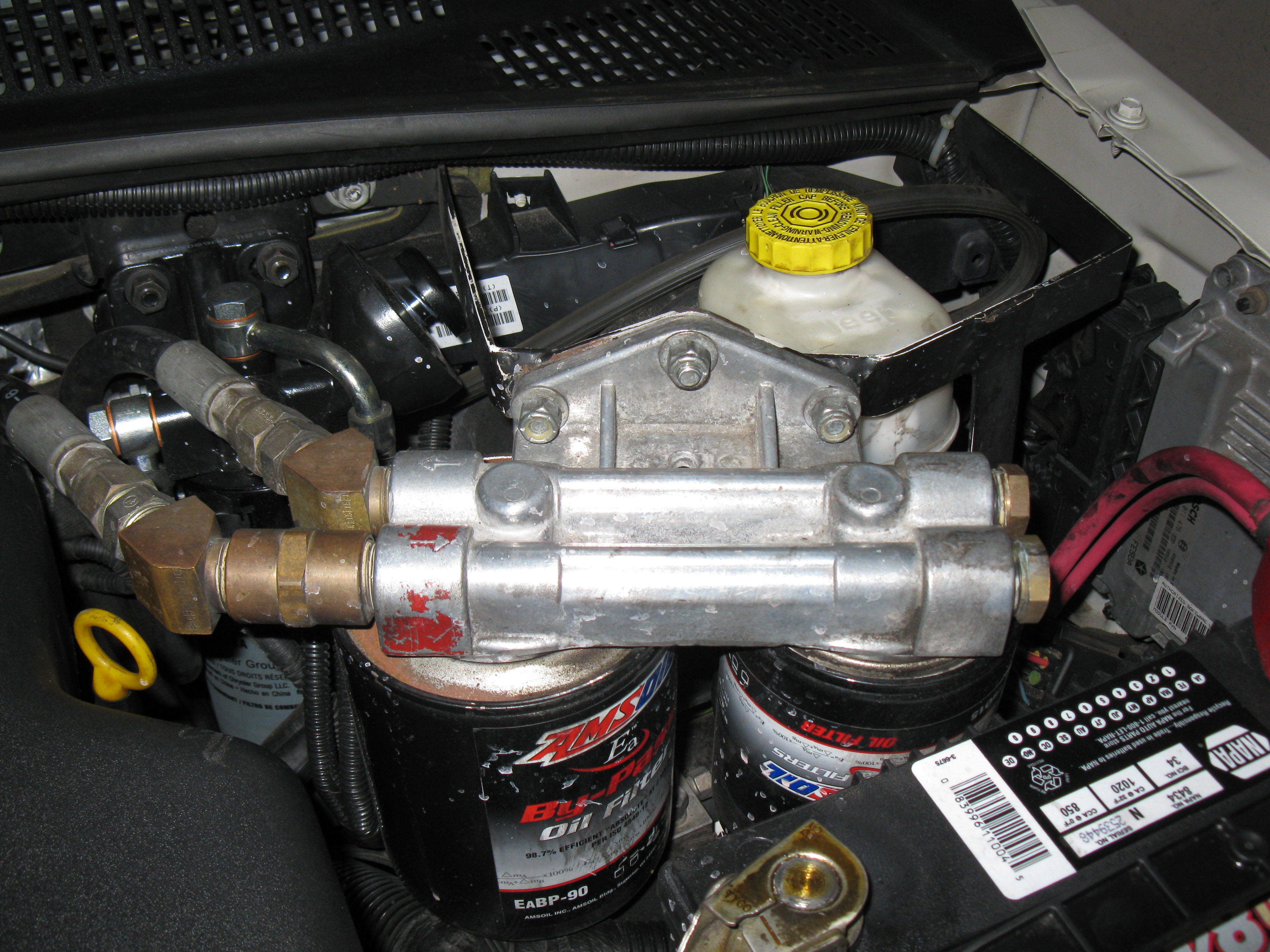
You're right. But the Amsoil kit has 2 filters, Amsoils 2 micron absolute "bypass" filter and a standard full flow filter which just happens to be the same one that we use on our jeeps. Oil flows through both filters at the same time with the bypass filter getting <10% of the flow. What I was saying was that you can buy the bypass kit without buying Amsoil's $20 full-flow filter and instead go buy whatever filter you want from Walmart. Since the Bypass is the workhorse the main filter I doubt matters so much. This just brings the cost of the kit down.
Auberon wrote:
The philosophical question is do you wish to remove those particulates that docB notes. If the answer is yes then.....use bypass oil filtration.
I need to respond to what has been said by one party.
1 Running a Jeep for many is not a business - it is a hobby.
2 Who in their right mind would ever choose to buy a Jeep if they didn't like the feel of it. No-one doing cost-price analysis seriously would EVER buy a dang Jeep!!!
3 Cost price analysis of owning a Jeep is a joke. It IS expensive to run them compared to other cars. To arrest any of these costs would be an improvement (see my points re failures at end of post).
4 Choosing to do cost price analysis or not is philosophical in itself.
To illustrate further this is also philosophical:
When does a big thumping powerful stereo pay you back? It contributes nothing positive to allaying running costs, nothing to the resale value by end of life and it creates a philosophical need to for some nob to break into the vehicle and steal the unit plus insurance premiums undoubtedly increase.
Is the cost of installing a stereo ever paid back? NO!
In fact, full flow filters were a relatively new development of the 1930's and 40's. This was due to the fact that oil was so cheap and it was cheaper to replace the oil than add a full-flow filter. Then oil started top become scarce. It is not so long ago that filters were certainly not the norm. I can, in fact, remember when petrol (gasoline) was AUD 0.40 per imperial gallon!
SO:
Where do you select your endpoint of the equation for efficacy of oil by-pass filtration?
How does it improve ones overall maintenance costs or did was that guestimated also?
Also: Have their been any top end or low end failures in the Jeeps so outfitted? I have read of none.
That is a cost gain in itself over the failures. This may be a positive step towards prevention of those top and bottom end failures as a minimum benefit.
Those trying this are pioneers! I know of anecdotal evidence whereby a large marine engine with an positively finite amount of lubricating oil successfully escaped a terrible predicament using by-pass filtration. Please see the Jackmaster site.
If the life of an engines' primary components are increased to double or even trebbled (no-one can say until it's a proven case) can a useful cost analysis be anything less than speculation and based on better than opinion and supposition regarding the speculated unknowns in the determination of the end point.
I believe the cost analysis came up because the FS-2500 kit cost so much more than the Amsoil kit and someone(might have been me) brought up a question about whether it really filtered that much better than the Amsoil unit, or if one would actually see a tangible benefit with the FS-2500 over the Amsoil. There were some bold Percentages thrown around in that thread that, in my eyes, meant nothing since we didnt know what it was a percentage of. I believe what I had said was that 50% less wear than an extremely small and insignificant amount of wear is essential no wear. I did an analysis of the time to payoff between the two units using the manufacturers suggested OCI's (factoring filter costs, oil costs, and initial kit costs) to show how one would compare to the other in the long run.
With that said, the FS-2500 looks like an excellent kit and is made for the jeep so it's much more plug and play.

 Login
Login Register
 FAQ
FAQ Search