tjkj2002 wrote:
Boiler wrote:
tommudd wrote:
If you can find a
Kilby gas tank skid can't beat it , or build one like it


Check my sig...
Can you jack up your KJ from only the gas tank skid without even making it bow?
I know you can with a Kilby gas tank skid(I know since I had to when doing my SFA swap),and we're not talking about a stock(or anything close to it) KJ either.
I can't believe we're still having this argument

I'm not making this stuff up or using rules of thumb, or repeating what some welder or wheeler told me. I'm a degreed engineer who has been designing machinery out of aluminum and steel for 12 years. I do the strenth analysis, functional design, hydraulic and electrical design, testing, and fabrication support for said machines. One of my latest designs was an aluminum scissor lift, aluminum chain-driven platform and aluminum roll-out extension for Bell Aerospace, which is sold and shipped with every V22 helicopter to the military. It has passed all of their testing, including life-cycle tests (40,000 cycles with full capacity). This was the first aluminum scissor for lifting personnel that I've ever seen. The point is, if you need it to do a job, and design it accordingly, aluminum is a safe material to use, like steel. I've seen my share of parts that fail that were made from steel...
Anyway, in reply to your question. Long answer:
All metal "bows" (read: deflects elastically) when a load is applied, even if is a tiny amount. One structure made from steel might bow 0.002", while the exact same sized structure made of aluminum would bow about 0.006". Thats not a random number. Steel has a modulus of elasticity of 2.9 x 10^6 while aluminum's is 1.0 x 10^6. So it is 3x more springy under the same load.
But so what?
Small amounts of elastic deflection would be good in a skid plate, and thats what it is, small. You might not even see it unless you're measuring it.
My skid is thicker, more completely covering of the gas tank, has diagonal gussets that increase rigidity, and since it is completely welded higher up the side, it has more resistance to "bowing" as a whole due to increased beam cross section. It also weighs less than half of the kilby (32 lbs vs 72 lbs). Plus I'm still making mine. Everywhere I go to look at the Kilby says they are discontinued.
Short answer:
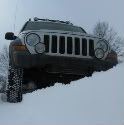
Yes. You can see the wet spot on my tire where it was sitting on the ground. They were spinning freely (open diff confirmed!

). I took pictures of the deflection using the level but you can't see anything. In the back where the radius is, there is nothing visible to the level. In the center of the skid, where it is unsupported, it was about 1/16" deflected. Once I lowered it back down the deflection went away, like deflections do.

_________________
2005 KJ Renegade
Fabrications for sale:
Aluminum Roof Rack (See Page 9)Aluminum Gas Tank Skid --
Radiator Skid --
Front Strut ShimsComing Soon: Rear Bumpers with lots of options

 Login
 Register
 FAQ
 Search




 Some of the SFA conversion guys have gone that route, but they kinda fall into the hard-core bucket.