Regarding FCA.. With the CRD it stands for Fiat Chrysler Automobiles, and is usually spat out in derision.
The term Flow Control Actuator is
never used by Mopar in reference to
the CRD, the reason being the confusion that it's causing here, as this engine has a Flow Control Valve, (FCV) that is completely different, but sounds confusingly similar.
To avoid confusion, with the CRD, the proper term is FQS. Fuel
Quantity Solenoid. In
the CRD case, it most perfectly describes what it is, and what it does.
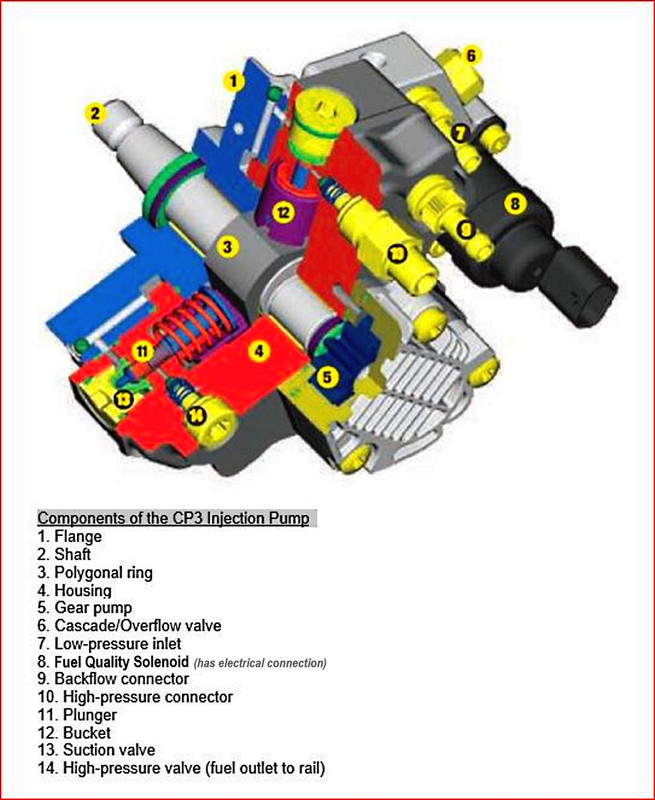
The FQS, WWDiesel has properly described where it is, what it is, and how it does it. My only modification is that it's properly called FQS rather than FAC or FCA, and that it's the component that the ECM uses first to make quick adjustments to correct under-spec rail pressure. As far as hydraulic circuit location, it is positioned between the Cascade Overflow Valve and the high pressure pump unit. It's static condition is 100% max flow. It's fully energized condition is as close to no flow as it can get.
The one on the rear end of the fuel rail is FPS (Fuel Pressure
Solenoid) (releases fuel when the pressure is out of spec
TOO HIGH) Also an electronically (PWM) controlled valve. It's static condition is OPEN (no fuel pressure can build), and the energized condition is CLOSED (MAX pressure)
The one in the middle of the fuel rail is Fuel Pressure
Sensor. Instantaneous condition information, observed by the ECM, and used to command solenoid adjustments.
Sensors tell the brain (ECM) what is happening and every environmental parameter it wants to know, so it makes the right decisions regarding individual commands.
Solenoids, relays, valves, etc, turn the resulting commands into actions, and the cycle continues as long as the engine is running correctly. (Closed loop condition) A couple years back I read somewhere how many times per second the ECM reads info and makes adjustments, and it was pretty astounding. I can't remember exactly at this time, but many hundreds, perhaps thousands, but for all of the things it watches and adjusts, I was impressed. And it's OLD tech at this point! (but then, so am I

)
The Cascade Overflow Valve (COV) is not an electronic component. It is a mechanical valve that directs fuel flow into, through, and (both directly and indirectly) out of, the CP3, and serves a couple of functions. The one WWDiesel doesn't mention, is removal (limited) of air in the fuel. It works on the same principle that FASS units use (air bubbles in pressurized fuel are much smaller, and easier to bleed away)
Cascade, refers to the fact it deals with multiple processes depending on pressures provided
Overflow is due to it directly returning all (most)
excess fuel back to the tank (or pre-LP pump in other applications) As well as all of the lubrication fuel and inter-component leak-by fuel. It is in this function that a limited amount of air-in-fuel can be returned to the tank. I should say that although I use the word limited, it's capability much greater than one would imagine, and If you're having air-in-fuel drivability issues, you're sucking more than a few little bubbles.
0-44 psi, it does pretty much nothing other than pass fuel through. (cranking fuel supply. No restriction)
45-72 psi fuel is passed into the internal lubrication passages. (to supply lubrication before pressure is built) Hydraulic Circuit diagram, between the LP pump, and the CP3 body/lubrication passages
73+ psi fuel is now able to pass to & through the FQS, into the high pressure pump cylinders, through the check valve, and out to the fuel rail. Hydraulic Circuit diagram, between the LP pump and the FQS.
When working, the CP3 in our rigs will progress through these steps, easily, under 2 seconds. Properly functioning in NEW vehicle condition should be within 2 revolutions.
At this point, I have to apologize and admit I've had a dissection project I've not gotten around to for about a year and a half. That is to go through a CP3 in detail, like I have with the FQS, the FPS, and the fuel rail.
Thermorex donated it. I have it. I just have been kind of overwhelmed with other things, mostly Doctor-related, considering my daily energy and pain levels. It has been kind of an inexcusably long time though. My goal is to go through it, with pictures, etc, and see if I can determine why it was under-performing.

 Login
 Register
 FAQ
 Search