| LOST JEEPS http://www.lostjeeps.com/forum/phpBB3/ |
|
| Turbo help needed! (BIG pics now, dial-up warning) http://www.lostjeeps.com/forum/phpBB3/viewtopic.php?f=5&t=39913 |
Page 1 of 2 |
| Author: | geordi [ Thu Feb 05, 2009 3:54 pm ] |
| Post subject: | Turbo help needed! (BIG pics now, dial-up warning) |
Ok, I've got a big problem. The Jeep stranded me b/c I didn't want to risk any damage to it. Here's what happened: Started normally this afternoon, first time starting today. Everything sounded fine. Driving to class, I accelerate to pass someone, and after I do, the computer seems to have put it into limp mode. Power falling off. I didn't notice at this second if anything was different about the sounds, didn't see any smoke, but I mostly coasted to a spot where I had to stop and make a turn, and I heard a metallic clattering noise. Stepping on the gas to make the turn (almost no power at this point) I see a good sized puff of black smoke from the exhaust. I stopped the engine immediately at this point. Checked the oil - NONE on the dipstick. The CRD had driven just 3 miles at this point. The outlet hose to the intercooler is coated on the outside with oil and residue, can't exactly tell if it is fully intact, but it seems to be. Started the motor again for a few seconds, the metallic clattering (think of the sound of putting a straw into the blades of a fan) is from the area of the turbo. Thoughts? Suggestions? Places to inspect? My plan right now is to dump in a gallon of oil and see if I can determine where the leak is, and try to get it home safely. I'll put in more if it needs it. Better to bleed, then try to run it dry. My Jetta did something similar, and it was just the air hose that had ruptured, but the lack of oil concerns me a lot. Where are the oil lines on the turbo? Can they be serviced directly? |
|
| Author: | gmctd [ Thu Feb 05, 2009 4:08 pm ] |
| Post subject: | |
Pull the inlet duct, see if there is a stick or small varmint in the compressor blades - see if the shaft spins smoothly - move the shaft side-to-side, up-to-down, in-to-out, see if compressor blades hit the aluminum housing at any point |
|
| Author: | onthehunt [ Thu Feb 05, 2009 4:26 pm ] |
| Post subject: | |
STOP STARTING THE ENGINE!!! You know something is wrong and are risking more damage. Have it towed and diagnose the problem. No oil on the stick is not good. Hopefully it's just the turbo and not engine related. If the turbine is junk DO NOT drive it. |
|
| Author: | MTB_TDI [ Thu Feb 05, 2009 4:28 pm ] |
| Post subject: | |
I wouldn't put more oil in and start it up until you know what happened. If you do decide to do that, pull the glow plugs to make sure you don't hydrolock. My brother popped a turbo once and the oil got sucked into the cylinders and hydrolocked it. It wasn't pretty. He learned a hard lesson on that (at least he was able to fix it himself) and more importantly, Do as gmctd says, check the impeller for dampage. Also check you intercooler, if there is a ton of oil, you'll know why your dipstick doesn't show any oil in the engine. If there is oil in the intercooler, it was destined for your cylinders!!!! |
|
| Author: | geordi [ Thu Feb 05, 2009 4:44 pm ] |
| Post subject: | |
Yea, I hear everyone on the possibility of hydrolocking. My situation has changed slightly in the last few minutes. The CRD is still where I left it (I hope) but I remembered that I need a towing vehicle tomorrow to deliver a generator. Looks like I need to rent a truck for the day, I'll use that to drag the Jeep home. I will check on all the suggestions made so far, pulling the air lines was the first thing I was planning anyway. If the shaft wobbles at all... Then I know what I will need to do, but paying for it becomes a problem. More updates later today. |
|
| Author: | warp2diesel [ Thu Feb 05, 2009 6:15 pm ] |
| Post subject: | Turbo shaft will have a little play, a little |
geordi: Most of us who have worked with turbos know how much play is OK and what is excessive. Most turbos have oil on both sides of the bushings so they float on oil. Small pins keep the bushings from spinning in the housing bore. If the blades show no evidence of contacting the turbine housing, that would be a good sign. I have used the old rule with turbos, " If the blades have touched the housing, its junk". Don't let a PARTS SALESMAN make the determination, once you have read GMCTD's, onthehunt's, mine and other postings, you know a hundred times more than the parts guy does. Options if it is junk are: 1) New Turbo, 2) New center section and reuse the housing (let the turbo rebuilder determine this one), 3) Remanufactured Turbo, 4) Good used turbo. I have done all of the above and had them last for years. Since you tow a lot, consider an EGT gauge, you may have cooked the turbo a few to many times and not known it. Good luck |
|
| Author: | geordi [ Thu Feb 05, 2009 8:17 pm ] |
| Post subject: | |
Warp: Yea, I think an EGT is in my future if I have to get any deeper into taking this thing apart. UPDATE: Ok, finally got everything home (dragged it unpowered) and pulled the intake box out to get some room to play. Intake hose and pressure hose to intercooler had oil inside them, but not what I would consider excessive. Inside the turbo, don't know about the oil content, but this is the big discovery: I can only get my fingers to touch anything on the air intake (center) of the compressor side. NOTHING WILL ROTATE AT ALL. I honestly don't know if the blades I touched are supposed to rotate freely, but I couldn't get them to BUDGE with just my fingers. Felt like they were a solid part of the housing. Is this normal? I didn't feel even the slightest motion at all in anything. My biggest question right now, is where did the oil go. I needed this tomorrow morning to deliver a generator to a film set, but now I'm renting a truck from the same place. So the Jeep isn't going to move until I figure out what happened. But its going to be 16 degrees tomorrow morning... And my only transportation now is a motorcycle. Ask how happy I am about that. Right now, I'm thinking that with both air lines unhooked from the turbo's compressor side, I should be able to oil the engine back to spec (and figure out how low it really is) and let it idle for a few seconds safely while looking for a leak. Since I should be able to see the turbo vanes, I can see if they actually do rotate or not. Also I should be able to see if the turbo oil's pressure side is spraying anywhere it shouldn't... Like on the outside of the engine. Unless someone has a better idea for diagnosis. I'm all ears. How much does it cost to rebuild a turbo usually? |
|
| Author: | ATXKJ [ Thu Feb 05, 2009 8:28 pm ] |
| Post subject: | |
no idea about rebuild - new from Mopar Parts America is 867.10 (list is 1275) http://www.trademotion.com/partlocator/index.cfm?action=getJointLocator&siteid=214583 |
|
| Author: | warp2diesel [ Thu Feb 05, 2009 9:00 pm ] |
| Post subject: | Locked up is no good. |
geordi: You should be able to turn it with two weak fingers on the draw up nut with almost no effort. Locked, it is junk. Explore all your options, bottom line is what counts. Wear out your phone first. Reject any used turbos that have kissed the housing, even if all they have done is scratch the carbon on the exhaust side when running. Remember the clearance you feel dry is not what it will be when charged with fresh oil. If you get one used that looks good, feed a little oil (same as you use for engine) into the oil pressure side before you do the wiggle test to make sure the blades have not kissed the housing. To give you an Idea how free, if you were to hook up the turbo to an oil pressure source, you should be able to start it spinning with a good hair dryer. I would not test it with a Shop Vac because you may blast it with dirt and trash it out. Good luck, I need to get fitted for my Darth Vader mask tonight. |
|
| Author: | geordi [ Thu Feb 05, 2009 9:14 pm ] |
| Post subject: | |
Shee-it. That was what I was afraid of. So there isn't any kind of "protection" of the inner vanes, an outer section that doesn't rotate, hmm? crap. Frelling Chrysler design. I still need to figure out where the oil went, and how it could have killed itself that quickly. It was perfectly fine yesterday. Bugger. Anybody know of any upgrades in this area, since it looks like I'm now in the market for a hairdryer? Better yet... Anybody got a wrecked CRD or equivalent vehicle with one of these in it? What turbo is even in our CRDs? What other cars use the same one? |
|
| Author: | kdlewis1975 [ Fri Feb 06, 2009 12:47 am ] |
| Post subject: | |
The turbo is manufactured by Garrett which is a division of Honeywell. I would suspect that it's used in other diesels around the world. It's probably a matter of finding their part number, so you may not necessarily have to get it from Chrysler. I bought a used one off of eBay two years ago just in case I ever share your experience. Unfortunately, it's not a convenient spot for me to inspect and report the numbers and such on the housing. I could possibly dig it out this weekend for you and post the numbers...unless you have yours off by then. I do remember seeing somewhere on a forum or internet over a year ago where someone specified what model of Garrett turbo it was. |
|
| Author: | JeepinJarhead03 [ Fri Feb 06, 2009 1:48 am ] |
| Post subject: | |
Not to butt in on you guy's thread here, but what protection if any do the libbys have against oil fed run-away? By run-away, if you aren't familiar with it, once the cyl's start getting fed with oil from bad seals in the turbo etc, can cause the engine to start running on the oil, skyrocketing the rpm's until it runs out of oil or .. really bad things happen .. like breaking your wrist snatching the fully clamped hose off and falling between a snapon toolbox and a bucket of transmission shafts and laying there hoping that the saab diesel you were just working on that momentairly turned gasoline engine rated RPM's wasn't about to come out of your paycheck for the next 3 months. |
|
| Author: | ATXKJ [ Fri Feb 06, 2009 9:21 am ] |
| Post subject: | |
Stock they have a Flow control valve which will shut intake air unfortunately it's part of the EGR system (you have to choke the intake to get exhaust gas in) and so it's occasionally disabled (for non-highway use of course) however the full SEGR - keeps this intact although it generated a lot of discussion as to whether it was needed. sounds like your vote was that it is required. |
|
| Author: | warp2diesel [ Fri Feb 06, 2009 10:10 am ] |
| Post subject: | I hope this did not kill your turbo but check for coking! |
Some turbocharged engines fry the oil coming out of the turbo and coke up the return line. Mitsubishi had this problem with their Starion models for a few years before they changed the design. Since you tow a lot, there may be coking (like the stuff made from coal, not soda pop) in the return line. When the line clogs up the oil has no where to go but blow past the sealing rings and most of it gets forced into the intake. When you replace the turbo or have it rebuilt, make sure there is no excessive coking in the return line, it will be very obvious. A little coking around the outside of the turbo center section drain is OK, but if you can't see inside (many turbos you can see the shaft when you look up the drain, but I have not looked inside of mine) be skeptical. If you buy a used turbo, inspect the oil drain, if you see coking, the turbo may have been run too hot too many times. If in doubt on a used turbo, post a pic of the oil discharge and send out a PM to those of us who have had turbo hands on turbo experience. Be weary of a used turbo that looks like it has been cleaned up too much like they are trying to hide something. You want a turbo that has been pulled off an engine that had some other problem. Honest sellers post pics showing the turbo from all angles. Hope this helps |
|
| Author: | Uffe [ Fri Feb 06, 2009 2:48 pm ] |
| Post subject: | |
JeepinJarhead03 wrote: Not to butt in on you guy's thread here, but what protection if any do the libbys have against oil fed run-away? By run-away, if you aren't familiar with it, once the cyl's start getting fed with oil from bad seals in the turbo etc, can cause the engine to start running on the oil, skyrocketing the rpm's until it runs out of oil or .. really bad things happen .. like breaking your wrist snatching the fully clamped hose off and falling between a snapon toolbox and a bucket of transmission shafts and laying there hoping that the saab diesel you were just working on that momentairly turned gasoline engine rated RPM's wasn't about to come out of your paycheck for the next 3 months.
I was just thinking this would be my route to go, trying to grab the boost hose off the intake manifold Breaking a wrist? Does that hurt? |
|
| Author: | warp2diesel [ Fri Feb 06, 2009 4:01 pm ] |
| Post subject: | Intercooler acts like oil trap |
JeepinJarhead03 wrote: Not to butt in on you guy's thread here, but what protection if any do the libbys have against oil fed run-away? By run-away, if you aren't familiar with it, once the cyl's start getting fed with oil from bad seals in the turbo etc, can cause the engine to start running on the oil, skyrocketing the rpm's until it runs out of oil or .. really bad things happen .. like breaking your wrist snatching the fully clamped hose off and falling between a snapon toolbox and a bucket of transmission shafts and laying there hoping that the saab diesel you were just working on that momentairly turned gasoline engine rated RPM's wasn't about to come out of your paycheck for the next 3 months.
Oil likes to stick to stuff like inter cooler cooling fins. Since the intercooler cooling fins are much cooler than the hot engine oil, this oil separation is even more enhanced. Yes some of the oil will go into the intake, but I would bet that most of it will end up in the bottom of the intercooler and need to be drained and flushed out. Most of the old Diesels that have run away were not fitted with intercoolers and with a high mounted turbo all of the oil will have no place to go but down and into the intake. Our turbos are mounted lower than the intake, on the opposite side of the engine, and the intercooler bottom is even lower yet. Runaway could happen on our CRDs, but it would be like accidentally shooting your self in the foot with the gun taken apart and all the ammo locked up. It would be a good idea for geordi to check and possibly do the intercooler drain, clean out and flush after the turbo failure. I am sure he will have time to let the intercooler rest on its side and drain out the oil at least as he is waiting for his replacement turbo to arrive. |
|
| Author: | Sir Sam [ Fri Feb 06, 2009 7:34 pm ] |
| Post subject: | |
Does your turbo look like this?
|
|
| Author: | gmctd [ Fri Feb 06, 2009 8:15 pm ] |
| Post subject: | |
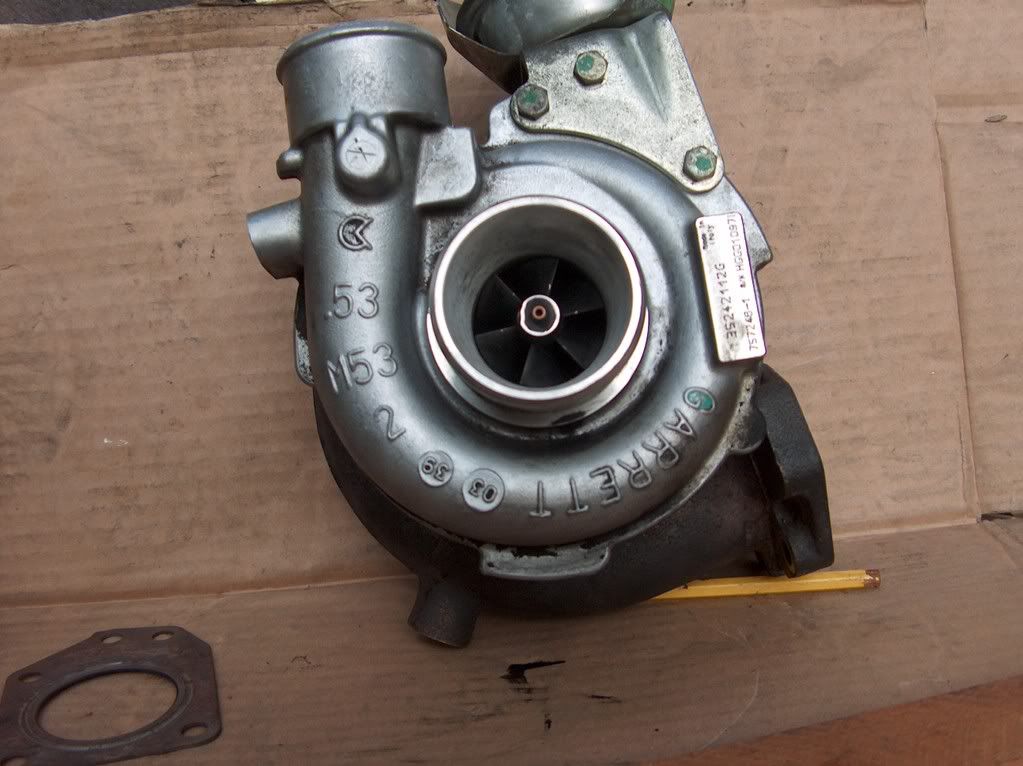
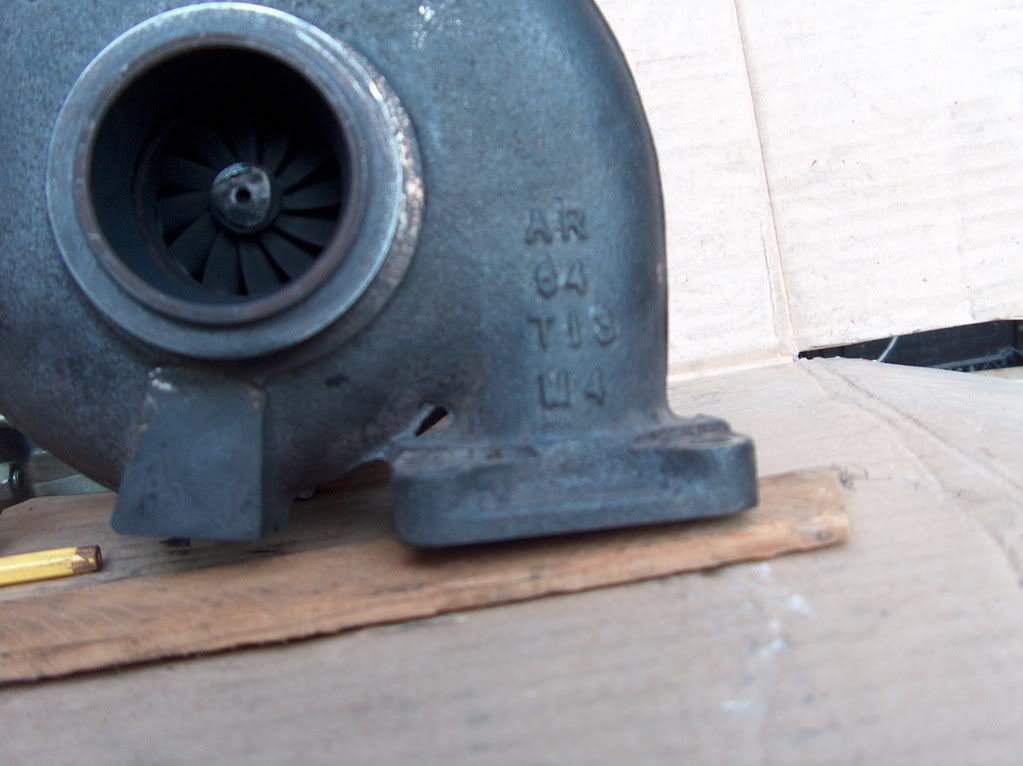
Should look like this: http://www.lostjeeps.com/forum/phpBB3/vie ... 072#361072 .53 compressor A\R - that's the measurment of the radius from the shaft centerline to the exact center of the nozzle area, in the case of compressor: where velocity becomes pressure
.64 turbine A\R, T13 exhaust flange config (same as for .049 model airplane engines!!) - to get quicker spoolup, reduce the A\R number - to allow more exhaust flow, increase the A\R - the Variable Geometry Technology turbine does just that by altering the turbine snail configuration, moving the nozzle as required to make best use of engine exhaust gas energy output, which is temperature, pressure and volume\velocity - low at low rpm, high at higher rpm and greater loading (towing'n'such)
|
|
| Author: | geordi [ Fri Feb 06, 2009 11:00 pm ] |
| Post subject: | |
Sir Sam wrote: Does your turbo look like this?
No, this is what mine looks like now on the exhaust side:
And the compressor side:
And the oil drain, for the curious:
The results of the autopsy are as follows: Death was caused by catastrophic shaft failure at speed, loss of oil was NOT pumped into the engine or intercooler, but pumped into the exhaust pipe. I strongly suspect that I will have a Batmobile Model 101 Smoke Screen when I finally get it running again. Now... Can people help me decipher the numbers? I think GMCTD did, but I want to make sure. If I want to match this unit, then I look for a Garrett that has the same numbers on both sides? What about the VNT deal? Does that change anything? Last but not least: With a failure like this... What could have caused it? Any way to prevent this in the future? Any chance of a rebuild at all? You guys have been a HUGE help on this so far... Oh, one other thought: If I can somehow connect that banjo bolt to the oil drain (bypassing the non-existant turbo for the time being) could the car move without the assistance of the hairdryer? I REALLY don't have many other options at the moment, and I have classes to get to. |
|
| Author: | Sir Sam [ Sat Feb 07, 2009 3:07 am ] |
| Post subject: | |
fun stuff, your lucky the shaft didn't complete separate. when that happen oil and just freely pour into the exhaust. I had that happen on a 88 subaru.........talk about smoke, I have never seen a car blow so much smoke...........just gawd awful tons of smoke. Mr LaForge, there have been many CRD turbos on ebay very cheap(less than $100), I never bothered to pick one up because I didn't feel the need. I know some of our other members did, maybe they still have it sitting and around will loan you one? |
|
| Page 1 of 2 | All times are UTC - 5 hours [ DST ] |
| Powered by phpBB © 2000, 2002, 2005, 2007 phpBB Group http://www.phpbb.com/ |
|