| LOST JEEPS http://www.lostjeeps.com/forum/phpBB3/ |
|
| CRD cooling system http://www.lostjeeps.com/forum/phpBB3/viewtopic.php?f=5&t=86985 |
Page 1 of 2 |
| Author: | BoarX [ Fri Aug 04, 2017 12:21 am ] |
| Post subject: | CRD cooling system |
Greetings, As a new owner of CRD I am puzzled by the design of its cooling system. I have pretty solid understanding of "conventional" cooling operation, found on my previous passenger cars like Mazdas and Hondas. However CRD one is distinctly different - unlike "conventional" one, here the cap with valves normally found on the radiator is now on the expansion tank, which, unlike on most other vehicles, is under pressure. Also the radiator is equipped with the relief valve on top, ostensibly for getting rid of bubbles. Now, I am not looking for a set of instructions describing the draining or refilling the system - there are multitude of them on the net, many somewhat contradictory. Instead I am trying to locate the sensible description of the system functionality. Is this strange setup a diesel thing? Seems unlikely, but what do I know? Thanks in advance for any pointers! |
|
| Author: | flash7210 [ Fri Aug 04, 2017 7:37 am ] |
| Post subject: | Re: CRD cooling system |
The cooling system is not that strange and not a diesel thing. Lots of GM and Chrysler cars and trucks are setup that way. Just think of the coolant tank as a coolant reservoir, an extension of the radiator. And it has a overflow tank too. It's just built into the reservoir tank. Just follow the little black hose that is directly below the radiator cap. And the plug in top of the radiator is for letting air out when refilling. |
|
| Author: | papaindigo [ Fri Aug 04, 2017 9:12 am ] |
| Post subject: | Re: CRD cooling system |
Flash is correct. To put it another way the coolant tank on the firewall is the "top" of the radiator. |
|
| Author: | GordnadoCRD [ Fri Aug 04, 2017 9:48 am ] |
| Post subject: | Re: CRD cooling system |
As Flash has pointed out, the side of the reservoir towards the center of the vehicle is the overflow / recovery tank. There is a port in this section to the rear of the assembly that is open to atmosphere. It must be, so the recovery tank doesn't develop backpressure during overflow, or vacuum during recovery. Just fyi in case, so you don't get confused by an open port that goes nowhere. |
|
| Author: | BoarX [ Sat Aug 05, 2017 3:29 pm ] |
| Post subject: | Re: CRD cooling system |
Ok, thanks guys, but persnickety me has more However the main coolant reservoir has yet two other relatively thin hoses connected to it. One of those (long) starts at the bottom and looks to be connected to the intercooler, which makes sense except for the great air bubble-forming potential in its top section. Or is it a return hose with the flow directed towards the main reservoir? I am also still perplexed about the function of another thin hose with connects the top of the main coolant tank with the thermostat - what is that supposed to do? Just helping bubbles to escape thermostat body? My apologies for being so inquisitive Great weekend everyone! A. |
|
| Author: | PZKW108 [ Sat Aug 05, 2017 4:33 pm ] |
| Post subject: | Re: CRD cooling system |
The CRD also have a viscous heater part of the cooling system, it help to warm up the coolant by friction during cold weather. its located under the thermostat , you will see a A/C type clutch pulley and two small hoses atach to it. this one is a diesel thing !! |
|
| Author: | GordnadoCRD [ Sat Aug 05, 2017 8:37 pm ] |
| Post subject: | Re: CRD cooling system |
What we're referring to as "Coolant Tank" or "coolant reservoir", The FSM refers to as a "Coolant Degasser Tank". That is the main function of the long hose to which you refer. Besides the short hose running from the pressure relief cap to and from the overflow portion of the bottle, There are 2 smaller hoses to the pressurized side. One very long that provides a path to separate air from coolant in the outlet side of the radiator. Another relatively short, that provides a path to separate air from coolant from the thermostat housing. This shorter one also provides a coolant bypass function when the thermostat is closed. I'm sure Turbo-Diesel-Freak can expound, as he is the licensed engineer and inventor that must be consulted whenever anything involving the CRD thermostat housing is discussed. In either case, the aerated coolant returned from the circulating coolant, is replaced by non-aerated coolant delivered from the bottom of the tank to the inlet side of the water pump. |
|
| Author: | BoarX [ Sun Aug 06, 2017 3:14 am ] |
| Post subject: | Re: CRD cooling system |
Ok, thanks again, things are getting a bit clearer! Maybe Turbo Diesel Freak can pitch in when he got a moment - thanks in advance! With all the hoses this system looks rather complex compared to the traditional one. Probably this arrangement is more suitable for the engines with widely varied cooling load, did I guess it right? Otherwise it is hard to justify extra complexity and space for much bigger two-section "coolant degasser tank". Curious consequence of the presence of the big degasser tank with substantial amount of air in it, is noticeable pressure differential between the system and atmosphere present in the cold engine as revealed by the hissing sound which occurs on opening the main cup. That same pressure differential must of course be there in traditional system too, but due to the little amount of air under the radiator cap, it is not nearly as noticeable on cap removal. I started this thread because I am trying to pinpoint a mysterious leak which leads to substantial loss of coolant. I have seen an older thread here on the same subject, but it didn't look conclusive. Cheers, A. |
|
| Author: | GordnadoCRD [ Sun Aug 06, 2017 6:07 am ] |
| Post subject: | Re: CRD cooling system |
BoarX wrote: Ok, thanks again, things are getting a bit clearer! Maybe Turbo Diesel Freak can pitch in when he got a moment - thanks in advance! With all the hoses this system looks rather complex compared to the traditional one. Probably this arrangement is more suitable for the engines with widely varied cooling load, did I guess it right? Otherwise it is hard to justify extra complexity and space for much bigger two-section "coolant degasser tank".
More complex would be accurate, but the end result is also more efficient. A "traditional" cooling system has quite a bit of room for aeration, air pockets, and therefore has generally required excess capacity and resulting extra weight. Any air in circulation or trapped in pockets prevents the coolant from absorbing heat energy from engine metals as well as shedding heat energy via the radiator and heater core metals. Curious consequence of the presence of the big degasser tank with substantial amount of air in it, is noticeable pressure differential between the system and atmosphere present in the cold engine as revealed by the hissing sound which occurs on opening the main cup. That same pressure differential must of course be there in traditional system too, but due to the little amount of air under the radiator cap, it is not nearly as noticeable on cap removal. Usually the pressurized coolant cap has no pressure at cold (not running) temperatures. The primary function of pressure within the system (when hot) is it increases the boiling point of the coolant, as vaporized water (boiling) has the same effect as outside air (disrupts heat energy transfer) within the system. The degasser tank gives a place where trapped air can rise to the top, and be replaced by pure coolant exiting the tank at the bottom. I started this thread because I am trying to pinpoint a mysterious leak which leads to substantial loss of coolant. I have seen an older thread here on the same subject, but it didn't look conclusive. Go to your auto parts store, and buy some UV dye for use in the coolant system, and buy or rent a cooling system pressure tester. Add the dye and run per directions. When cool enough, remove all four glow plugs. Replace the coolant cap with the cooling system pressure tester. Pressurize the system to 14psi, and leave for an hour or so. If pressure stays constant, then there is no coolant leaking, probably the cap has failed and allowing coolant to leave via vaporization. If pressure has substantially dropped, then use the UV light and check everywhere around the engine, radiator, hoses, EGR cooler, Oil cooler, Thermostat, Water Pump, heater core(Inside too), reservoir tank, etc If pressure has dropped and you can see no source of leakage outside, then pull the injector relay from the power distribution box, and crank the engine over (air pumped out through the glow plug holes will be extremely loud) Any head or head gasket leak into a cylinder will immediately show up via the coolant leaving through the glow plug hole. If pressure has dropped, and no coolant comes out any glow plug holes, then either something was overlooked, or your leak is internal to the EGR cooler (exiting through the exhaust) OR exiting through the Oil Cooler (will show up via motor oil looking like a chocolate milkshake) Cheers, A. |
|
| Author: | BoarX [ Sun Aug 06, 2017 10:20 am ] |
| Post subject: | Re: CRD cooling system |
Wow, thanks for such detailed instructions, GordnadoCRD! I didn't think about EGR and oil coolers, in fact I have yet to find those beasts, but I won't bug you with that. Since my EGR is inactive thanks to GDI tune, I presume its cooling lines should be safe to "short circuit" bypassing the unit, no? This way the coolant will still be left flowing in the name of reducing potential for extra bubbles. Does it make sense to physically plug the EGR gas passage as it was suggested here even if it is inactive? One thing I know for sure, my engine oil is nothing like a chocolate milkshake, so some relief here Cheers, A. |
|
| Author: | GordnadoCRD [ Sun Aug 06, 2017 3:54 pm ] |
| Post subject: | Re: CRD cooling system |
BoarX wrote: I didn't think about EGR and oil coolers, in fact I have yet to find those beasts, but I won't bug you with that.
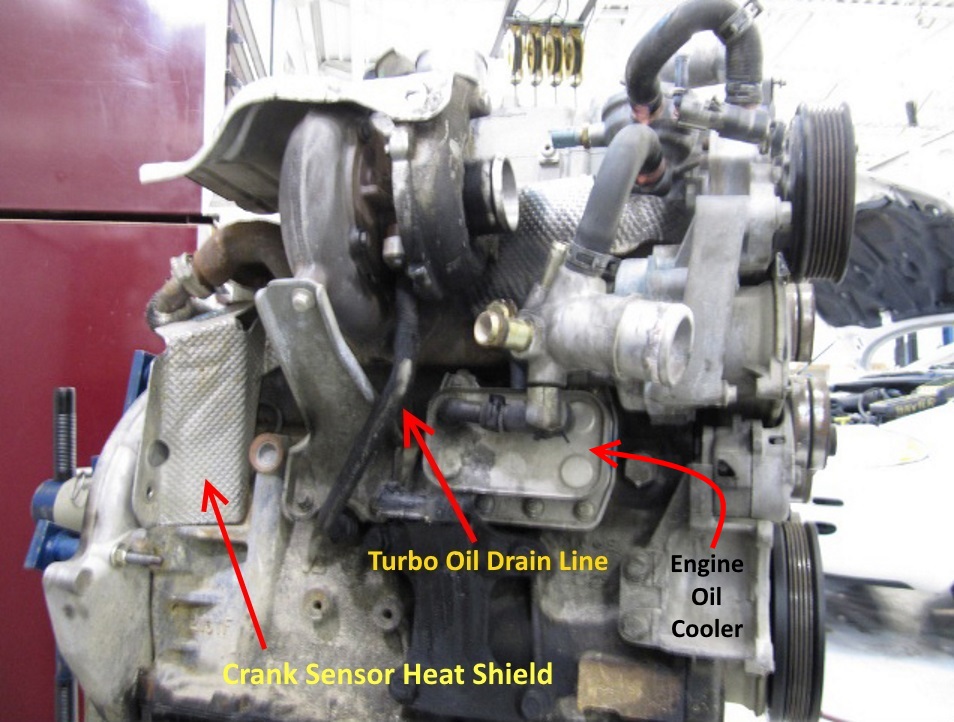
The oil cooler is on the RH side of the engine. behind and below the thermostat housing, and behind the water pump, bolted to the block. Water fittings are external. Oil passages are sealed by the gasket between the cooler and the block. Papaindigo has a photo image showing it clearly, but I can no longer link it. Since my EGR is inactive thanks to GDI tune, I presume its cooling lines should be safe to "short circuit" bypassing the unit, no? This way the coolant will still be left flowing in the name of reducing potential for extra bubbles. Even with a GDE tune, as long as it's still actively plumbed, there is still potential for leakage between the exhaust and intake (both are pressurized with potential to go either way) when the FCV plate fails to close completely. The EGR cooler is on the LH side of the block, behind and below the intake elbow, between it and the starter motor. It looks nearly identical to the oil cooler but it's bolted to the EGR valve assembly rather than the block. It also has external coolant hoses. IF you install the exhaust manifold plug (Weeks #2) so exhaust gasses can no longer pass through the EGR mess, Then you can replace the coolant hose passing from the 'Y' connector, directly to the cylinder head fitting (bypassing the EGR assembly). The best solution is the Weeks 1 elbow kit removing the entire devilish thing if you live somewhere that doesn't require detailed physical inspection for licensing. If you live somewhere that does require it, once you block off the exhaust gasses, just re-route the coolant hoses to bypass the egr cooler. (TIP! It's easier to reach if you remove the front drive shaft and access it from below. Same goes for #3 and 4 glow plugs.) Does it make sense to physically plug the EGR gas passage as it was suggested here even if it is inactive? YES! To physically plug, or completely remove the EGR is the only way to definitely positively prevent exhaust gasses from entering the intake, as well as preventing filtered, pressurized, intake air from escaping directly to the exhaust. One thing I know for sure, my engine oil is nothing like a chocolate milkshake, so some relief here Cheers, A. |
|
| Author: | BoarX [ Wed Aug 09, 2017 11:12 pm ] |
| Post subject: | Re: CRD cooling system |
GordnadoCRD, I owe you a beer, and more than one! If you are ever around Indiana or Illinois, let me know! Seriosly! Alex |
|
| Author: | mass-hole [ Thu Aug 10, 2017 1:22 am ] |
| Post subject: | Re: CRD cooling system |
I believe the GDE tune uses the egr as an exhaust pressure blowoff for the turbo if the manifold pressure gets to high. If you are going to eliminate the cooling lines I would block the egr off. Sent from my iPhone using Tapatalk |
|
| Author: | GordnadoCRD [ Thu Aug 10, 2017 2:00 am ] |
| Post subject: | Re: CRD cooling system |
I appreciate that, but I've gotten WAY more help from this forum myself, than I've been able to give. Just payin it forward. But I've got nothing against a beer.... ![]() But seriously, take a look at WWDiesel's CRD Cooling System Graphic. http://www.lostjeeps.com/forum/phpBB3/viewtopic.php?f=98&t=87021&p=914669#p914669 That sucker is getting laminated and stuffed in my personal service manual. When I'm fighting a problem, it's way too easy to get focused on one part and lose sight of the other elements that can affect the system. |
|
| Author: | TURBO-DIESEL-FREAK [ Thu Aug 10, 2017 8:51 am ] |
| Post subject: | Re: CRD cooling system |
mass-hole wrote: I believe the GDE tune uses the egr as an exhaust pressure blowoff for the turbo if the manifold pressure gets to high. If you are going to eliminate the cooling lines I would block the egr off. Sent from my iPhone using Tapatalk mas-hole, that is not quite accurate. When developing engine tunes for the R428 engine that powers the CRD, Green Diesel Engineering discovered a program in the engine's computer that blips open the EGR system when the driver gets off of the fuel pedal quickly. This relieves spikes in pressure in the intake system in any circumstance where they can occur, thus eliminating turbocharger surge. The system was already present in the Liberty CRD as delivered to the dealer from the factory. GDE tunes merely keep that program operating in the engine's computer. In a nod to Seth Weeks at Sasquatch Motorsports, WWDiesel and other LOSTJEEPS CRD members, there is some debate as to the necessity of this program. It is absolutely necessary to have turbo blow off valves, (BOV), present in gasoline engines because they have throttle valves. Diesel engines do not have a throttle valve, and therefore there are some legitimate questions as to why this program is present in the CRD. Funny, though... there appear to be several online articles and youtube presentations discussing BOV use in diesel engines... www.dieselarmy.com/engine-tech/.../how- ... valves-bov www.youtube.com/watch?v=lqMcyCv5WRg www.youtube.com/watch?v=w3nrQ74g0QQ https://www.quora.com/How-does-a-diesel ... valve-work |
|
| Author: | TURBO-DIESEL-FREAK [ Thu Aug 10, 2017 9:08 am ] |
| Post subject: | Re: CRD cooling system |
BoarX wrote: Ok, thanks again, things are getting a bit clearer! Maybe Turbo Diesel Freak can pitch in when he got a moment - thanks in advance! With all the hoses this system looks rather complex compared to the traditional one. Probably this arrangement is more suitable for the engines with widely varied cooling load, did I guess it right? Otherwise it is hard to justify extra complexity and space for much bigger two-section "coolant degasser tank". Curious consequence of the presence of the big degasser tank with substantial amount of air in it, is noticeable pressure differential between the system and atmosphere present in the cold engine as revealed by the hissing sound which occurs on opening the main cup. That same pressure differential must of course be there in traditional system too, but due to the little amount of air under the radiator cap, it is not nearly as noticeable on cap removal. I started this thread because I am trying to pinpoint a mysterious leak which leads to substantial loss of coolant. I have seen an older thread here on the same subject, but it didn't look conclusive. Cheers, A. BoarX: Some great answers are given in this thread to your inquiries. I would just like to add one thing... please check your upper radiator hose for a second thermostat valve stuffed into it. If there is one in that hose, REMOVE it.... the in-hose thermostat valve was a cheap Band-Aid fix for the cool engine operating temperature problem the CRD has. There are thermostat valves designed to run inside radiator hoses in certain applications, and typically what you will find is that a previous owner or some shadetree mechanic stuffed one in the upper rad hose of the CRD when the O.E. thermostat failed. The CRD engine was never designed to run a secondary thermostat valve, and serious consequences can result down the road if one is left in for any length of time. If an in-hose thermostat valve is used in conjunction with a failed O.E. thermostat, the result is that the bypass circuit of the cooling system is permanently shut down, and hot spots will form in your engine when the in-hose thermostat is closed. Warped cylinder heads and failed cylinder head gaskets are a very likely to happen. |
|
| Author: | mass-hole [ Thu Aug 10, 2017 1:13 pm ] |
| Post subject: | Re: CRD cooling system |
TURBO-DIESEL-FREAK wrote: mass-hole wrote: I believe the GDE tune uses the egr as an exhaust pressure blowoff for the turbo if the manifold pressure gets to high. If you are going to eliminate the cooling lines I would block the egr off. Sent from my iPhone using Tapatalk mas-hole, that is not quite accurate. When developing engine tunes for the R428 engine that powers the CRD, Green Diesel Engineering discovered a program in the engine's computer that blips open the EGR system when the driver gets off of the fuel pedal quickly. This relieves spikes in pressure in the intake system in any circumstance where they can occur, thus eliminating turbocharger surge. The system was already present in the Liberty CRD as delivered to the dealer from the factory. GDE tunes merely keep that program operating in the engine's computer. In a nod to Seth Weeks at Sasquatch Motorsports, WWDiesel and other LOSTJEEPS CRD members, there is some debate as to the necessity of this program. It is absolutely necessary to have turbo blow off valves, (BOV), present in gasoline engines because they have throttle valves. Diesel engines do not have a throttle valve, and therefore there are some legitimate questions as to why this program is present in the CRD. Funny, though... there appear to be several online articles and youtube presentations discussing BOV use in diesel engines... http://www.dieselarmy.com/engine-tech/. ... valves-bov http://www.youtube.com/watch?v=lqMcyCv5WRg http://www.youtube.com/watch?v=w3nrQ74g0QQ https://www.quora.com/How-does-a-diesel ... valve-work Yes, it is in the stock tune as well but I wanted to avoid confusion from the OP that the EGR is fully eliminated from the GDE tune, it is not. My suggestion was that if he was not going to totally remove it then block it off as to avoid the hot gases going through without coolant. I dont see a BOV as being a bad thing on a diesel. If the turbo is pushing 2.5x ambient pressure and suddenly you lose drive pressure on the turbine, thats a lot of force with nowhere to go. It may not last long since the engine is still turing, but I hear my turbo surge just driving around a parking lot and letting up. Sounds like its whacking at the air. |
|
| Author: | papaindigo [ Thu Aug 10, 2017 1:42 pm ] |
| Post subject: | Re: CRD cooling system |
mass-hole - some time back I asked Keith at GDE, based on some other discussions, if a) one had a GDE tune then b) could you leave the EGR connected to the exhaust AND disconnect the coolant lines to the EGR cooler. His answer was yes. Without putting words in his mouth I assume that's because any brief opening of the EGR in a CRD with a GDE tune is so brief as to not raise EGR temps enough to need cooling. Yes I know matters are different if the EGR is stuck open so exhaust gas is constantly shunted to the intake. |
|
| Author: | BoarX [ Fri Aug 18, 2017 12:04 am ] |
| Post subject: | Re: CRD cooling system |
Hi everyone, Thanks for all the great pointers guys, I am educating myself time permitting. In the meantime the mysterious coolant leak appears to be .... the blown head gasket! Shame on me for the failure to perform simple "coolant overpressure on cold engine" test. In fact, excessive pressure in the coolant tank is present on the cold engine even without running it! Some postings before I erroneously wrote that the hissing sound heard while opening cooling tank cap on cold engine was vacuum, but I was wrong - it was positive pressure. Relieving this pressure (to improve the "purity" of the experiment), running the cold engine and shutting it off after half a minute results in yet another noticeable pressure buildup. Thus my destiny seems to be new gasket and ARP studs unless there is another reason for the observed behavior. Weirdly enough the CRD is running just fine without any noticeable change is MPG. As a side effect, it looks like in this condition the system never develops any vacuum and thus fails to compensate for the lost coolant by sucking it from the expansion tank - mine remains full even with coolant level in the main contour dropping. Oh well. A. |
|
| Page 1 of 2 | All times are UTC - 5 hours [ DST ] |
| Powered by phpBB © 2000, 2002, 2005, 2007 phpBB Group http://www.phpbb.com/ |
|