Spike6901 wrote:
Fuel economy is defiantly a big issue now days. It is getting to the point that you need a little eco car to drive to work daily.
Also, think about (in the past) Jeep vs Toyota build strength. Jeep puts those dinky Dana's under the wrangler and if you wish to add a locker and some larger than 31" tires, you had better upgrade to 44's. Even the older Wranglers and CJ's were built with dinky parts like the AMC 20 and a horrible, unsync'd x-fer case (I speak from experience). Consider that the Cruisers had axles almost equilivent to Dana 60's, running 35's is no problem and the x-fer case shifts like butta'.
This may mean nothing now, but in the past, Toyota's trucks and cruisers were a far, far cry better than American versions as far as strength and ease of repair. I mean, with my FJ40 or with my '84 PU, all I needed to do practically anything was a 8,10,12,14 and 22mm socket/wrench and usually not even a manul becasue everything is so logical. On any of my Jeeps, I had better have a full set of English and Metric tools to even try. Again, this may be a mute point for the FJC.
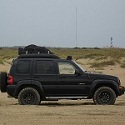
I would really like to see a comparision between the two in two categories by people who actually wheel: stock to stock, lifted KJ w/265's vs. stock FJC with 33's.
Check out these pics.
http://forum.ih8mud.com/showthread.php?t=90098What was the ring gear size, axle diameter & retention system, and pinion size of those D60'ish Toy axles? Did they come under the CJ-like L/C's, or the later, larger versions?
I got to admit I was thinking of the p.up's and the 4runner on the axle comment. The 8" Toy axle has a great reputation that I don't buy. Add some horsepower to those rigs and......hmmmm.... Toy's running swapped-in Dana & GM axles? Yep. Although it IS kinda hard to defend the D35, I would ask you to keep one word in mind when rating what you consider dinky: birfields.
Higher compression is a simple, proven way to improve power as it also allows timing changes... BUT... it requires higher octane fuel to avoid pre-detonation. I am betting that Toyota bumped the compression of its V6 to achieve more power, and that is why it specifies premium fuel. I'll also bet that the computer on the FJ will dial back the timing to prevent knocking on regular fuel. I believe that the ECM changes required while running regular fuel will make a noticable change in the power of the FJ. The premium octane requirement has been accepted in luxury cars, but I don't know if it will be accepted in more main stream vehicles.

 Login
 Register
 FAQ
 Search


 Point is, Toyota, overated, seriously.