DarbyWalters wrote:
The amount of "fresh air" that runs thru a Diesel since there are no throttle restrictions remains almost constant. The fuel delivery increases as boost and load are applied...that is why A/F Ratios vary so much on a diesel...
The turbo does "pack" more air in the cylinders under boost...but the "fresh air" only changes due to movement of the vehicle.
I am still trying to figure out what exactly you are referring to. The amount of fresh air that moves through the engine is absolutely
NOT constant. Nor is it "almost" constant. It is highly variable. The variability of flow has nothing to do with a throttle plate or lack thereof (gasoline engines also have a high degree of flow variability). A 2.8L 4 cylinder diesel engine is moving 5.6 liters of air at 1 RPM, at 1000 RPM and 0 PSI of boost. It moves 5600 liters of air if there is no restriction through the airbox, filter, ducting etc, or at the outlet. At the same 1000 RPM and 15 PSI of boost it is moving 11200 liters of air. In order to "pack" that air into the engine it has to move twice as much air through the airbox. But the effort to move it through the same diameter restrictions is more than doubled. Now this is all considering that the temperature of the air is not changing, however since we are talking about an internal combustion engine we have to factor in the heat that is added by the fuel. As the above mentioned 5.6 liters of air is heated to over 1000 degrees F, it's volume wants to more than double but cant which effectively multiplies the PSI to more than quadruple that of the initial 14.7 PSI of the intake air. So the initial 11200 liters of air that went through the air filter in one minute becomes 22400 liters of air that exits out the pipe. Multiply X 3 for accelerating to 3000 RPM on the Hwy ramp and you get 67200 LPM. That is a
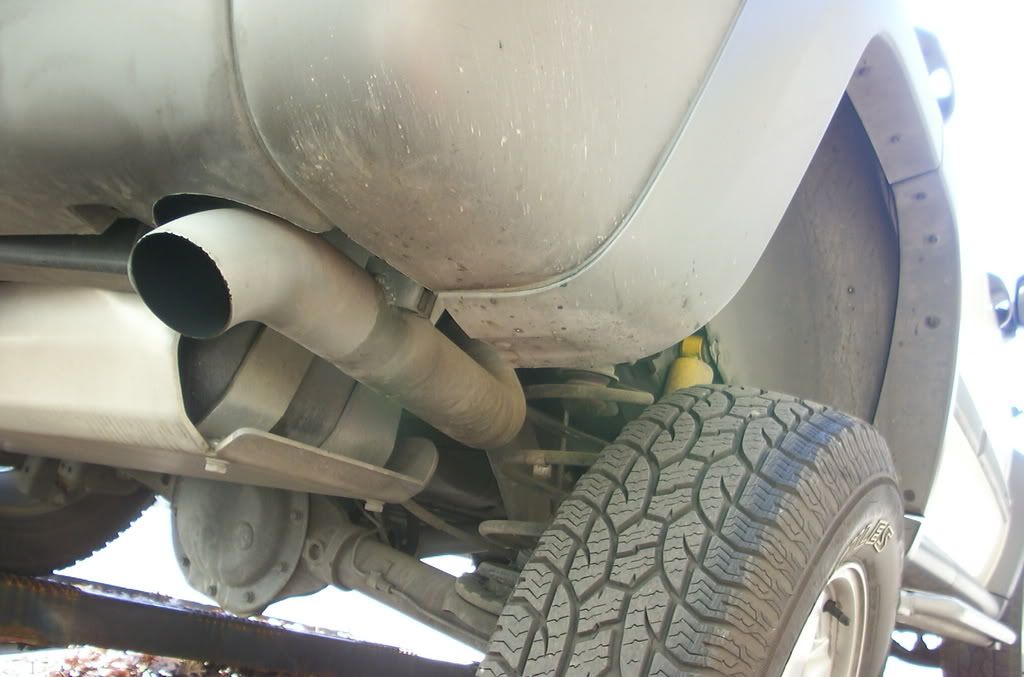
LOT of air to move through a 2" pipe (67 cubic meters). Anything which opens up the exhaust flow path can reduce the back pressure in the cylinders considerably which will improve efficiency and MPG. The A/F ratio has nothing to do with the restrictions to the air flow. If the engine is moving 22400 liters of air at 1000RPM, the A/F mix could be 5:1 or 80:1, it would not matter because the resistance to flow would still be the same. The amount of fresh air going through the airbox has nothing to do with vehicle speed. It will still move 22400 liters whether stationary on the dyno or moving down the highway.

 Login
Login Register
 FAQ
FAQ Search








 .
. If I ever add a chip or tune for more performance I may also add a 2 1/2 or 3 inch pipe for better flow and lower EGTs.
