painemann wrote:
Hoosier CRD, you are correct that most shops will tell you to wait until it fails to replace it! Hell even our favorite tuner guy said to do the same, and I am sure that a good percentage failures will result in simply lost power.
I am very paranoid when it comes to this Jeep after reading all the catastrophic engine damage cause by turbo failure, I don't think I need to explain what I'm talking about I'm sure most everyone reading this has an idea on what I am talking about! Being paranoid as I am with the jeep I figured I would not take the chance, the cost for a new turbo is nothing compared to engine replace or repair! I am obviously not the only one that feels this way if you read this whole topic most of the initial reply's were "PARK IT".
I didn't want to spend $80+ on a new oil feed line, it appears to be a stainless line that could be cleaned with little effort. Why do you recommend replacement of the line other then it being dirty?
I'm all for preventative maintenance. I have also replaced parts prior to ultimate failure for the sake of not having to do it in an inopportune setting. I have also seen/talked about turbo failures on Liberty CRDs where it was nothing more than a breakdown with a failed component. Turbos do not always fail alike, many do, some don't.
Here in my office, I have a box of CRD parts, for when the need arises, I like to call it prior planning. One of those parts is an oil supply line. I count four (4) bends in that line and would be more convinced that it is a cad-plated steel rather than stainless.
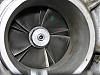
When a turbo does fail, or gets swapped out, one is "right there" at adjacent parts that are much easier to replace with bigger components out of the way. (How difficult was it to remove that turbo?) Given that the oil supply line is quite literally the life-blood of the turbo, it too is cheap insurance. Given that our unit has four (4) bends, I can see how it could be very hard to clean of any blockage. Coked oil is nasty stuff. It's baked on (or in) nooks and crevices and can be very difficult to clear. Realizing that you are installing a "new-to-you" turbo, it is still a good idea to at least run some brake parts cleaner, carb cleaner or pipe cleaners through the line to make sure that you know that it is clear. When one replaces a turbo with a new unit, it is penny wise and pound foolish to let the oil line remain. Again, cheap insurance. Think of it this way: You mean to tell me that you just spent $XXXX.XX dollars on a new turbo and you are not changing out the $XX.XX oil line? I see/hear of this happening all the time. I also see alot of premature failures of new turbos due to oil starvation because somebody got a case of the "Phukets". As I said previously, oil starvation is the #1 reason for turbo failure. Catastrophic failure is #2. As we used to say on the line, "It ain't sitting in my driveway." The choice is yours.
I can try to get a video of a new unit and the shaft movement therein. Admittedly, I have never posted a video to the web. I don't even know how to start that adventure. If I can get some help with posting the video, PM me please, then I am happy to show what a new turbo does and talk you through how to test yours. I believe that we have a new CRD turbo in stock.

 Login
 Register
 FAQ
 Search