Hmmmm
a LOT Of the ford guys talk about surging, and talk about their EGR systems acting as waste-gates....
not to mention... keith is programming these ECU's... he can SEE the waste-gate code.....
http://www.thedieselstop.com/forums/f25/turbo-surge-66431/Quote:
The 6.4L engine was designed to use EGR as a wastegate of sorts and has 25% EGR flow at max power. For peak performance EGR is not desired and with many tuning programs the EGR is turned off. With the EGR turned off the exhaust backpressure jumps to overly high levels resulting in lost power and un-needed stress on engine components.
http://www.rudysdiesel.com/_e/EGR_Delete_Kits/product/64-EGR/Elite_Diesel_EGR_Delete_With_Wastegate.htmhttp://www.dieseltruckresource.com/dev/turbo-surge-t215490.htmlThink about it this way:
Your exhaust manifold has some volume... think of that volume like the air tank on an air compressor..... you can turn your compressor off, but it would take some time to drain the tank if your only using a little bit of air....
The pistons are constantly pumping hot exhaust gases into the manifold.... this gets forced through the turbine housing of the turbo charger, and causes the the turbo to spin......
When you give the engine "gas" your pumping lots of hot exhaust gases into the manifold....
When you take your foot off the gas, the gases don't simply disappear, they take time to vent through the relatively small turbine housing..
Now the turbocharger has a built in waste gate, but because of the way it's plumbed, it only opens when the
intake pressure reaches a certain level.....
now... you mentioned you removed the throttle plate, and your saying that because a gas motor has a throttle body, the abrupt closing of the throttle body can cause surging because the air in the plenum / inter-cooler has nowhere to go.....
But what your failing to take into consideration is this:
Turbo lag works both ways: The turbo takes a times to spin up (build pressure in the exhaust manifold) and it takes time to spin down (release manifold pressure through the relatively small compressor housing / wheel)
When a transmission up shifts, and RPMS drop abruptly, an engine "pumps" way less air......
So your going up a hill, your at 3500 rpms, your exhaust manifold is at 200 PSI, cramming exhaust through your turbine
Your intake manifold is at 30PSI (guessing, never actually checked) and at 3500 RPMS, she's going though the air just fine.
Then you take your foot off the gas... your transmission up-shifts, your rpms drop to 1,200.....
this is where the EGR valve would open, and vent of some of the exhaust manifold pressure...
but you've blocked the system off, so instead of the manifold pressure dropping when you took your foot of the throttle, the pressure stays high....
With your intake manifold already pressurized but the engine no longer pumping air at a higher speed, your "pressure to flow" ratio of your turbo goes off the map. (this isn't a map for our turbo's I'm sure you can google it)
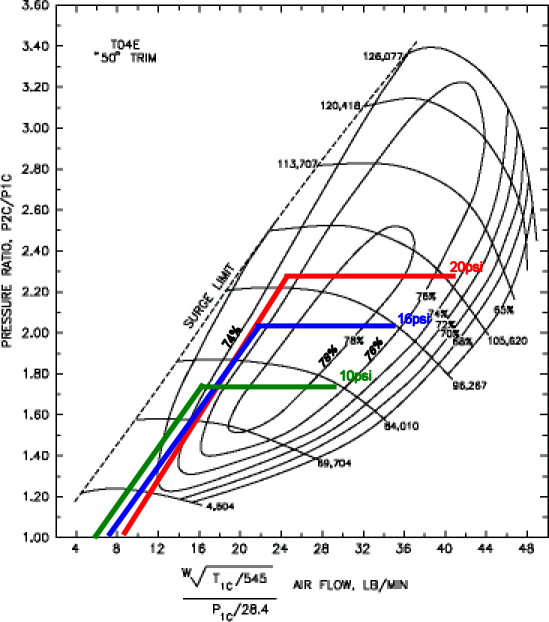
if you look at the turbo map, you will realize the problem.....
the turbos can generate a range of pressure ratios, and a range of flow, but the two have to cross somewhere on the map....
for example (Random numbers but just for argument's sake)
It can make 30PSI, but only between 200 and 500 CFM..... if you try to make 30PSI at 100CFM, your compressor will surge....
The manifold's main waste gate only opens to keep the intake manifold PRESSURE consistent... it's a spring and a diaphragm connected to your intake manifold.... The main waste gate has no idea whatsoever what the FLOW is through the engine......
look at this post from a dodge cummins forum:
Quote:
Since my new T/C was installed I've noticed more "Bark" in my turbo. When the T/C locks during the 3/4 shift it sometimes causes the turbo to bark. Is there anything I can do to prevent this besides letting off the throttle during the shift.
http://www.dieseltruckresource.com/dev/turbo-surge-t215490p2.htmlHe's talking about his turbo surging when his transmission goes from 3rd to 4th gear....
Lower engine RPMS = reduced air flow through the engine.....
Remember, we have variable vane turbos too... they are likely much more sensitive to surging.....
You deleted 2 EGR systems and blew 2 turbos..... I don't think it's a coincidence....
but then I Could be wrong....
here is more info for you directly from Garrett's website
http://www.turbobygarrett.com/turbobygarrett/surge_lineQuote:
Surge is the left hand boundary of the compressor map. Operation to the left of this line represents a region of flow instability. This region is characterized by mild flutter to wildly fluctuating boost and “barking” from the compressor. Continued operation within this region can lead to premature turbo failure due to heavy thrust loading.
Surge is most commonly experienced when one of two situations exist. The first and most damaging is surge under load. It can be an indication that your compressor is too large. Surge is also commonly experienced when the throttle is quickly closed after boosting. This occurs because mass flow is drastically reduced as the throttle is closed, but the turbo is still spinning and generating boost. This immediately drives the operating point to the far left of the compressor map, right into surge.
Surge will decay once the turbo speed finally slows enough to reduce the boost and move the operating point back into the stable region. This situation is commonly addressed by using a Blow-Off Valves (BOV) or bypass valve. A BOV functions to vent intake pressure to atmosphere so that the mass flow ramps down smoothly, keeping the compressor out of surge. In the case of a recirculating bypass valve, the airflow is recirculated back to the compressor inlet.

Quote:
On a GAS turbocharged engine, there is a throttle flap that slams shut when you drop off the gas pedal. This could easily cause a pressure backwash in the intake, as the pressure tries to escape out the intake, reversing the turbo.
Your assuming that surging is only possible when air flow goes "backwards" through the compressor side of the turbo.... this is not the case...
The science of gases and liquids going over surfaces at high speeds is very complex...
Think of a boat's prop in water, now think of a boats prop cavitating.... little vortexes of vacuum at various points on the propeller... Doesn't sound like a big deal, but it's as if someone put your boat in neutral and you can't "grab" the water......
When your compressor wheel tries to spin, and force the air past it at a certain pressure, it can only do this in a certain "window" of flow... if you go too far to the left on that window (compressor map), the gases (in this case air) do strange things around the compressor wheel.... This causes all kinds of strange forces on the turbo's rotating assembly..... not just "Trying to turn the compressor wheel backwards, which would in turn unscrew it because it's threaded on a certain way"... it also forces it sideways which puts a bunch of load on the thrust bearing, and in extreme cases it can cause violent changes in loading that can break shafts and fins.....

 Login
Login Register
 FAQ
FAQ Search


